The other day, I was changing Noah’s pull-up (his third poopy diaper in a 90-minute span! (when, oh when, will he be fully potty-trained?)), Bella asked Jonah what he wants to be when he grows up.
He quickly said, “Superman.” (It should be noted he wore a Superman shirt that day)
Then, I asked Stella what she wanted to be when he grows up, and she said quite simply, “A baby.”
So, that’s that.
Really, really glad we’ve got that settled, and apparently, she won’t have to go to college after all.
(April 15, 2013; 9:12 p.m.): About eight hours ago, the world changed for the worse again. It changed in the way the world changed on 9/11 or during Oklahoma City or during Columbine or during Sandy Hook. The two explosions that occurred more than four hours into the Boston Marathon were world-changers on a planet filled with world-changers. It was a domestic bombing, like 9/11 and Oklahoma City, that has scared and saddened us. The death of a child, like in Columbine and Sandy Hook, has made us weep for the future’s loss and the loss of their future.
Seven hours ago, my 3-year-old children went to bed for their daily nap. I kept the TV off when they were downstairs, but as soon as their bedroom door closed and their turtle night-light flickered to life, I immersed myself in the news coverage. And the anger. And the sadness. And the goddammit-what-the-hell-is-wrong-with-this-world of it all.
I seethed and I teared up and I tweeted, and my children slept, blissfully unaware that the world outside our doors had changed once again.
They’re 3, and the world to them is infinitely good. They spend their days playing and learning in preschool and going for walks with mommy and daddy. They love Sesame Street and Toy Story and their baby dolls and looking at the pictures from our recent Disney cruise. They don’t know heartbreak or evil or the goddammit-what-the-hell-is-wrong-with-this-world of life. Their sadness leaks out when a toy is lost. Nothing more and nothing less. I envy them for that.
Four hours ago, after my kids had emerged from their slumber (and the TV had been darkened), my daughter pulled out a pair of my wife’s brown shoes. She traipsed around the kitchen with her oversized footwear, pulled out her orange toy binoculars and declared, “I seeee you, Daddy.” I turned away from the sadness on Twitter and smiled.
Then, I helped her and her brother build a bear circus* out of Lego blocks.
*The other day, we built a caterpillar zoo. Today it was a bear circus. Somehow these things exist in my kids’ minds.
Every parent, I’m sure, ponders their children and the innocence that eventually will disappear forever. The country cries, and soon enough, the kids will cry along with it. But for now, they laugh and they drink their milk and they chase each other around the island in our kitchen.
Two hours ago, a buddy of mine tweeted to me that it was difficult having to explain what had happened in Boston to his 5-year-old son. What was his reaction? I asked. Did he understand?
“He was confused that an explosion could be real,” my buddy wrote.
The world probably changed today for his child, just like it did for all of us. Explosions are real. Evil does exist. A road race can lead to destruction and death.
Ten hours from now, when my kids wake up for a brand new day of sunshine and innocence, they won’t know any better. But they will soon enough, and that’s when our job as parents will change. We will have to be the ones to teach them people are good and that life can be beautiful. And that the loss of innocence can be a blessing. That it teaches us how to survive.
Their world, at some point, will change. Hopefully, we’ll teach them how it can be for the better.
Ben Roethlisberger is the most important player to roam the field for Miami University in many decades. I hesitate to call him the best RedHawks/Redskins player ever, though there’s a case to be made that he’s the top quarterback that the school has ever produced. But best ever? Because of former standouts like Paul Dietzel, Mel Olix and Travis Prentice, I’m really not sure.
Either way, nine years after leaving the school for the Pittsburgh Steelers, Roethlisberger was inducted into the school’s Hall of Fame on Saturday. Obviously, that’s deservedly so.
Roethlisberger’s* induction, though, reminded me of Sid Gillman, and the reasons it took him until 1991 for the Miami gatekeepers to deem him HOF worthy.
You have to understand that Gillman, to this day, is not well-received by many Miami old-timer alums.
*For the record, I asked Roethlisberger during the run-up to Super Bowl XLV if he knew anything about Gillman for the book I was writing, and he admitted that he couldn’t tell me much.
Gillman was the first in the long-revered Cradle of Coaches, but there are no monuments to him on campus. His likeness will not be made into a statue inside the stadium. There were people who refused to talk to me when I was researching the Sid book because they did not want to discuss the man who left Miami for good after the 1947 season. For the record, that’s 66 (!) years ago.
Sid Gillman made his mark at Miami, but he is also not much more than a blemish on its memories.
“You can have him. [Gillman] owed everybody in Oxford when he left,” Lucy Ewbank, Weeb Ewbank’s widow, said as she attended a Miami football statute ceremony in 2010 (at the time, she was 104 years old, and she lived another 15 months). Her opinions are not atypical at Miami.
The reasons for that are pretty simple. After four seasons of leading the team to a combined record of 31-6-1 record, Sid left Miami to work as an assistant under Red Blaik at Army, and one year later, he returned to southwest Ohio to take the University of Cincinnati head coaching job. Then, he stole many of Miami’s coaches (including head coach George Blackburn) and many of Miami’s best players to join him in Cincinnati.
Miami hired Woody Hayes, who had to rebuild the program that Gillman had raided, and the bitterness remained for many years. Hayes and Gillman eventually fixed their problems, but I can understand Miami’s disgust with Gillman.
And that is why it took Gillman until 1991 to make the Miami Hall of Fame. The Gillman family believes Paul Brown was one of the biggest reasons it took so long for the school to induct Gillman (since Brown played and graduated from Miami and since Brown and Gillman were pro football rivals that never reconciled, it’s not a stretch to believe that theory is true). For god’s sake, Gillman was already a member of the College Football Hall of Fame, so yeah, it was a bit of a stretch that Miami hadn’t seen fit to recognize him.
One of my most thrilling research discoveries for the Sid book was when, while going through folders at the Miami sports information office, I ran across a stack of letters from 1977 that urged the school’s decision-makers to allow Gillman to enter the Hall.
There had been a reunion for the 1947 Sun Bowl team that year, and Gillman’s former players got to talking about the injustice of their coach not being allowed into the Hall (though it could be argued that the honor is reserved for those who graduated from Miami, and Sid, instead, had a diploma from Ohio State). So, his former players decided to write letters – which I read more than 30 years later – to convince the administration that Gillman should be included.
“There was a very strong flavor for his induction,” Ara Parseghian told me in a phone conversation. “People recognized what they had learned from Sid and didn’t think about the negative things, where he got his ass in a jam.”
The former players penned their thoughts on work stationary ranging from the General Motors Corporation to Century 21 to Stevenson Photo Color Company. There was maybe a dozen of them, and as I fanned them across the desk on which I was working, it was a colorful display that repeated the same thing over and over again: Sid deserves to be in the Miami Hall of Fame. His mark on Miami is obvious for all to see. He needs to be recognized. Do it now.
For a guy who I argue falls through the cracks of NFL history, it’s amazing that old grudges kept Gillman out of the place where the people should have known exactly how much he had meant to the program. But that was Sid. An outstanding coach who had made too many enemies. The wart on the index finger pointing the way forward.
Despite all the success and because of all the drama, the school punished him for many years – deservedly or not.
The best part of the Sun Bowl reunion letters, though, was the immediate response from the administration. John Dolibois, the Miami VP of development and alumni affairs, dashed off a quick note to AD Dick Shrider in which he wrote: “I was literally besieged at the Sun Bowl party about Sid Gillman. I now agree … that his time has come.”
And it did. Just took another 14 years to make it happen.
I was a Led Zeppelin fan in middle school all the way through high school. That was probably my dad’s influence. He didn’t have any of Zep’s vinyl LPs in his collection, which I loved thumbing through on occasion (mostly, probably, to see a certain Blind Faith album cover) but he introduced me to Zeppelin through the magic of compact discs.
The first real rock concert I ever attended was Aerosmith at Lakewood Amphitheater in 1994, but the first concert I was supposed to attend was an ill-fated Coverdale-Page show that was cancelled, apparently because of slow ticket sales. I remember exactly where I was when I heard the announcement on 96 Rock that the show would not go on, that I would not see Jimmy Page play with David Coverdale, and I’m sure my wailing that echoed through the two rooms of my parent’s basement could have competed with any of Robert Plant’s bluesy screaming on Led Zeppelin I.
I loved Led Zeppelin in my teenage year, more than I loved Pink Floyd, more than I loved Def Leppard, more than I loved most any other band that had ever existed.
But as many romances do, that infatuation faded after high school. In college, I listened to other genres – harder and faster music. Mike Patton and Ben Harper and the Pietasters and System of a Down and Sevendust. I owned all the Zeppelin albums, but they received less and less play as I got older. In fact, I only recently added the entire Zeppelin catalog to my iPod, and those songs only pop up randomly now and again when I’m on shuffle (curiously, I seem to get more songs from Coda than any other Zeppelin album).
I seem to recall the three surviving members of Zeppelin reuniting for one last show in London in 2007, but I barely put in the effort to find clips from the show on YouTube. I had moved on.
Recently, though, I found myself watching a Zeppelin press conference online to drum up publicity for the band releasing that live performance from ’07 on a DVD/CD called “Celebration Day.”
I sat transfixed for 45 minutes watching Robert Plant and Jimmy Page ignore questions about why they won’t reunite for a proper tour, and after Zeppelin was honored at the Kennedy Center Awards in December, I DVR’d the band’s appearance on the Letterman show.
Then, I was tooling around on YouTube a couple weeks ago, and I found this – probably the best version of Stairway to Heaven I’ve ever heard. Heart’s Ann Wilson wails on that song the way Plant used to sing it (but can’t anymore), Jason Bonham plays with the power and intensity of his late father, and the choir … my god, that choir. It’s brought a tear to my eye every time I watch it (not unlike Plant in the audience that night).
Since then, I’ve been on a Zeppelin kick. I downloaded “Celebration Day,” and I discovered it rocks hard enough to knock me back to high school. I’ve watched the Heart version of Stairway probably 10 times. And I thought back to Feb. 28, 1995, when some buddies and I saw Page and Plant play at the Omni in Atlanta when they toured to support their first faux Zeppelin album (John Paul Jones wasn’t involved in this project, leading him to joke later that Page and Plant must have misplaced his phone number).
That concert experience isn’t on my top-10 best list, but there’s one moment at that show that I’ll never forget. In fact, it might be the best song I’ve ever heard performed live.
Page/Plant were 10 songs through their 21-song set list, and up until that point, they sounded like so many of the Zeppelin bootlegs I had heard. Solid, but gritty. Decent, but rough. Powerful, but a little bit fuzzy. If you’ve ever heard the soundtrack to The Song Remains the Same, you’ll know what I mean. Zeppelin sounds kick-ass, but the band doesn’t sound great either. If that makes sense.
On that winter night in 1995, though, the band kicked into “Achilles Last Stand,” and everything changed. The night, which had been mediocre so far, was saved by this 10 minute-piece of music. We were in this 15,000-seat arena, and until that point, it hadn’t felt intimate. But Page started on that slow, meandering guitar lick and Plant started on those vocals, and suddenly, a rock concert morphed into magic. I’d experienced that at a show once before (during “One of These Days” at a 1994 Pink Floyd concert when that bass line and my pounding heart melded into one), and since then, it’s happened maybe one other time (Faith No More playing “Caffeine” at the Masquerade in Atlanta in 1998).
An experience that can never be recreated, but one that never leaves your system. An experience that’s transcendental and ephemeral and utterly unforgettable.
A couple nights ago, I found that moment on YouTube.
You, of course, won’t feel what I experienced that night in Atlanta 17 years ago (if I had to pick the exact second that everything changed, it’s at the 1:57 mark). When I watched the video, I didn’t feel it either*. But I could see the moment was there. I couldn’t feel it the same way I did when I was 16, but I knew it existed in a past life. That has to be good enough for the present.
*Though I’d never seen any video from this show, I did have a bootleg recording of Page-Plant’s performance that night, so I’ve heard this version of the song, maybe, two dozen times. I’ve never had the same reaction that I had that night, though watching the video for the first time was pretty freakin’ awesome.
Now, the question Zeppelin receives in every media session in which they participate is why they won’t get back together and do one last tour. Sometimes, Jimmy Page is elusive and mystical. Sometimes, Robert Plant looks pissed that he’s even being asked the question. Sometimes, it seems like John Paul Jones can’t answer because he’s day-dreaming.
Apparently, it’s Plant that doesn’t want the reunion, and the rest of the band is at his mercy.
You know what? It’s kind of perfect that they’re probably done as Led Zeppelin. It preserves that night in 2007 when Zeppelin, 27 years after it had broken up following the death of John Bonham, returned for two hours of triumph to be rock gods one last time. It preserves that 10 minutes of “Achilles Last Stand” on Feb. 28, 1995. Zeppelin doesn’t need to be The Rolling Stones or The Who and tour on old songs and faded memories into their AARP years.
One perfect YouTube video will have to be good enough for me; it will have to be good enough for all of us.
And it’s comforting to know that I can see that moment whenever I want. When I can think about my dad and I listening to Zeppelin in his Mazda RX7, when Zeppelin was the best band in the world, when I screamed about a cancelled concert, when Plant’s voice sent chills up my back.
Rock gods don’t ever die. But sometimes, they realize that their time together is gone, that there are other aspects of life to explore. Sometimes, rock gods just want to move on while the love and everything you ever felt about them remains forever the same. But only in the past.
You have to have love stories like this one, regarding how former Texas Tech coach Tommy Tuberville sneaked out of Lubbock in the middle of the night to take the Cincinnati job. Well, it wasn’t really the middle of the night. No, it was during the middle of dinner.
[Texas Tech recruit Davonte] Danzey, along with two other prospects — lineman Sunny Odogwu and receiver Javess Blue — and “eight to 10” coaches went to dinner last weekend as part of Danzey’s official visit to Texas Tech. Tuberville was included in the group, but according to the offensive line prospect, the former Red Raiders’ coach did not finish his meal with the group.
“The waitress brought our food out, and we thought (Tuberville) went to the bathroom, but he never came back to dinner,” Danzey told 247Sports.com. “The next thing I know, the next day, he made an announcement that he’s going to Cincinnati.” …
According to Danzey, Tuberville dodged questions early in the dinner regarding how long he planned to be at Texas Tech.
Now, people might decry the way Tuberville left the program (here’s hoping one of his coaches that night picked up the dinner tab, at least), and I know people in Cincinnati are still upset at the way Brian Kelly left the Bearcats program for Notre Dame and with how Butch Jones left for Tennessee (though neither was as dastardly as Tuberville’s process).
But believe me, this kind of deception has been going on forever. Like, with … oh, I don’t know … Sid Gillman in 1954 when he left Cincinnati to take the NFL’s Los Angeles Rams job. From my biography on Sid:
“I was interested in pro football. Most college coaches aren’t interested. They are two entirely different games,” Gillman said. “But while I was interested in the game, I was more interested in California. When I flew into Chicago, there was a hell of a snow storm and that kind of renewed my California dream.”
The Rams offered $25,000 a year and the promise of sunshine year-round. How could Gillman turn that down? When Esther[, Sid’s wife] heard the offer, she exclaimed, “$25,000! What are we going to do with all that money?” And so, they went.
Gillman, though, couldn’t help but burn some of the bridges he had built so sturdily in Cincinnati. The same way he denied he was leaving West Point for the Bearcats until he actually got on the plane, Gillman said he would not leave Cincinnati. And the story goes that in one of the final days of his tenure, Gillman was meeting with boosters when he was called away to the phone. When he returned, he said, “Gentlemen, I’m here to stay. I’ll continue at UC indefinitely and put this program where I want it.” Thirty minutes later, he received another phone call. After that one, he returned to the group and said, “Gentlemen, I’ve just accepted a job as head coach of the Rams.”
Arguably, Sid’s version is worse than Tuberville’s, but at least he showed his face one last time before leaving. And at least Sid had the decency to make a funny story out of it.
One of the gunmen who protected us eating a popsicle.
There was a time in my life when I believed I would keep track of Israel, stay up to date on the news halfway around the world, think about how the daily turmoil affects those who live in the threat of constant danger. Israel is the land of my people, the home of a few of my relatives and a significant symbol to those who cherish it and to those who hate it.
After college, my wife and I traveled there as members of a Birthright Israel trip, an organization that provides Israeli tours for young Jewish adults where the objective is “to change the course of Jewish history and ensure the continuity of the Jewish people by strengthening Jewish identity, Jewish communities, and solidarity with Israel via an educational trip to Israel for Jewish young adults around the world.”
It was an incredible time. We had just graduated from college, and we went with two other friends (and several bus-loads of others just like us) to experience the culture, the beauty, the history and the importance of this country. We made friends that we’ll always remember fondly, we explored a country and culture we had never experienced, and we felt a sense of pride that we were visiting a dangerous land so our lives could be enriched.
I’m not a religious man, and this trip didn’t make me any more so (though the first time I touched the Western Wall, I felt a surge of spirituality ripple through me that I’d never felt before and have not felt since). At the end of the trip, as we sat on the beach of the Mediterranean, the group talked about its post-Israel goals and what we had learned from traveling the country from Tel Aviv to Jerusalem, from the Red Sea to the Dead, from the desert to the big city. I declared that I would follow the world of Israel from afar through newspapers and websites. I believed it was important that knowledge of the region would somehow make me a better, more informed Jew. That knowing what was happening in Israel would make me a better global citizen, a better person.
Naturally – and I probably could have predicted this at the time – my interest in Israel has wavered. I don’t keep up to date with the latest micro-conflicts. I know who the prime minister is and what American commenters think of him, but not much else.
This doesn’t make me a lousy Jew. It just makes me less informed than I once thought I should be.
These Israeli soldiers could have destroyed me.
There are waxes and wanes for the fighting that occurs in that holy land, and when we there in 2001, it was a relatively peaceful time. A day after spending our evening in the Russian Compound neighborhood in Jerusalem, though, a car bomb exploded there. A few weeks after we returned to the U.S., a Tel Aviv nightclub was blown up. We were told never to ride the buses while in Israel, and we were not allowed to visit any of the street markets. The danger never truly fades away.
Now that the conflict has begun again between Israel and those who want to destroy her – and the danger becomes a daily obstacle of life – I think of my relatives who live outside Tel Aviv and I wonder about their daily lives now that the bombing, the missiles and the fear have returned. I sent my relative a message the other day via Facebook, and here was his entire response.
It is, in my mind, beautifully-written and eye-opening.
Thanks for writing. I’m grateful for your concern. The situation is a little worrying but could be much worse.
We are located in the Sharon region which is outside the 40 km radius around the Gaza Strip which has been bearing the brunt of the attacks. It was pretty shocking that over the weekend, rockets were fired into Tel Aviv and Jerusalem. These targets have not been attacked in many decades, and Tel Aviv is much closer to us, and a reminder of our vulnerability. Of course, the people who do live in the 40 km radius (in major cities such as Be’er Sheva, Ashkelon and Ashdod) have been experiencing living hell for 12 years now, and a particular acute form of it over the last week or so when about 700 rockets were launched, each with mass-casualty-causing potential. Now, we who live in the center of the country are exposed more directly to the same terrors, though at a much lesser intensity. For the people in the South though, the terror is much more real. The missiles are landing in their cities and blowing up their apartments. I have a personal connection to the most serious attack which took place on Thursday where a rocket struck the fourth floor of an apartment building killing three people in the town of Kiryat Malachi. I was in Kiryat Malachi last month and had a meeting in a cafe a few blocks from where a rocket landed.
Everyone I know has the radio on almost 24/7 and at some times actually 24/7. Over the Sabbath, when those who are religiously observant do not operate electronic devices, I set up a radio in the corner of the apartment at a minimal volume so that it wouldn’t disturb our Sabbath experience but from which I could glean news updates when I got close and leaned my ear into the speaker. I’m at work now and am watching the TV which now is being broadcast 24 hours a day on the internet. The broadcast gets interrupted every 10 minutes or so with the presenter announcing in a panicked voice “Alert in Ashkelon. Alert in Ashkelon (or whatever the city the missiles are travelling to)” and the air raid sirens are sounded. Then the broadcasts switches from the studio to live feed from the border with Gaza and in real time you see the missiles taking off from Gaza and hurtling toward Israeli cities. One gets a very cold, life-draining jolt, viewing these projectiles, knowing that they are on their way to destroy lives, but not knowing on whose heads they are going to land, and possibly those of you and your family. As I am writing these words, the broadcast switched to show rockets on their way to Tel Aviv.
There was a large call up of reserves on the night between Friday and Saturday. Again, this had particular challenges for religiously observant reserve soldiers who don’t answer the phone on the Sabbath. There was an eerie feeling on Saturday morning when I was in synagogue and didn’t see several of my friends who prayed there with me on Friday night. After the service, I asked their wives what happened and they said that in the middle of the night, they got phone calls (which they never receive on the Sabbath) and when the phone kept ringing, they decided to answer. Although Sabbath violation is one of Judaism’s most serious sins, it is a commandment to violate the Sabbath to preserve human life and being called up to defend the country is considered preserving human life. The army sent buses and before the sun was up, my friends were driven out to their staging areas in different parts of the country.
In my family, there has been a lot of anxiety, despite our attempts to spare our children from the reality we face. It’s difficult to do since we’re tuned in to the news for so many of our waking hours. I’ve taken to walking around the apartment with a radio in my pocket and one earplug in my ear to keep up to date and not unnecessarily worry my family. On the first day of the war, I asked my wife to keep the kids close to home and that evening we did a missile drill where we descended from our fourth floor apartment to the stairwell of the second floor, which the home front command notes is the safest place to be.
My middle daughter is anxious about many things and predictably, the situation has brought out many of her latent fears about our enemies trying to kill her. My youngest daughter, who usually is sangfroid about everything, pleaded to be able to stay in our arms. My wife told her (somewhat disingenuously) that there’s nothing to worry about but she replied, “I know mommy, but my heart is beating so fast, and I’m just scared.” My older daughter, who has a better understanding of history and realpolitik, muses about whether this was what it felt like to be a Jew during the Holocaust. I tell her (not disingenuously) that this is nothing like the Holocaust, but at 13, and with rocket alerts on the screen every fifteen minutes, I can’t expect her to be sensitive to the differences.
There is a lot of anxiety and tension about what happens if and when the sirens go off in our city. First of all, unless it’s Saturday, it’s likely that we will all be in different places. My two younger daughters are in the same school, but my oldest daughter studies in another city and my wife and I work in two different cities. In addition, in the event of an attack, the city’s security forces will likely be called to other places and in the context of my police service I will be called up to command the city’s western police precinct. My wife and children are not appreciative of the possibility that I will be out of the apartment and dealing with the general safety of the city’s residents rather than being in the 2nd floor stairwell with them.
There are a few bright spots in an otherwise frightening reality. On the first day of the war, the air force knocked out about 100 long range rockets whose range would have allowed them to hit our area. This was a remarkable feat because the rocket silos were placed in crowded Gazan neighborhoods a dozen yards or so from mosques, playgrounds and schools. It takes a remarkable amount of precision to hit the rockets and not the civilians. So far, I’m grateful and full of awe, that only 30 Gazans have been killed, and most of them I believe are Hamas militants. Another source of wonder is the iron dome rocket interception system developed together with the U.S. These anti-missile missiles have successfully intercepted over 80% of the incoming rockets. It’s the only such system in the world and we’re grateful for it. It’s the reason only 3 Israelis have been killed so far, despite the nearly thousand rockets they’ve shot at us. Thirdly, there is an amazing sense of unity and kindness that comes out during these difficult times. Our community is hosting a number of families from the South, giving them a break from the hourly need to run to the shelter. People are increasing their good deeds and charity giving. Bitter political arguments that usually characterize our society have been put aside. In general, there’s a kinder, more loving tone in every day interactions.
Thanks again for your concern. I hope my letter finds you well and gave you some insight into our experience.
No matter what side you’ve taken, know that there are hundreds of thousands of people — Israelis and Palestinians — who live this life every day. One day before Thanksgiving, here’s hoping that some day all of them can find peace.
In the course of arranging interviews for my Sid Gillman book, I came across a number of people who didn’t want to talk. Most who refused didn’t want to speak to me on the record or off.
This didn’t happen when I was interviewing for my first book, Bearcats Rising – well, that’s not true; one old University of Cincinnati running back named DeMarco McClesky, one of the better players in the 1990s, declined to talk to me through another former player. But for the most part, I found that when I told someone I was writing a book, they were more than happy to talk for as long as I wanted. And even the ones who normally were terrible quotes transformed into great talkers.
Hell, Rick Minter – who probably got screwed out of coaching UC in the Big East and had a real reason to be bitter – sat with me at a Frisch’s restaurant for three hours discussing things good and bad as I asked him tough questions about his job performance. And then he bought me breakfast afterward.
But for this book, there were a number of people (and they were from very specific areas of Sid’s life) that refused to speak about him. Ask just about any coach currently working in the NFL or anybody retired who knew of Sid or worked for him, and they’re likely to go on for hours extolling his virtues.
Then, however, I tried to talk to former Chargers receiver Lance Alworth, a Hall of Famer who was probably the best receiver in AFL history and who played under Sid. I called him at least three times at his office in California and left three messages (some on his voicemail, some with a secretary). I never heard back.
I tried to talk to former Chargers quarterback John Hadl and reached him at his office in Kansas. He said he would have to think about whether he wanted to engage with me, even though he said he and Sid were extremely close (after playing for Sid in San Diego, he hired Sid as his offensive coordinator when Hadl coached in the USFL). I told him I’d call him back for an answer. I did. Left him a voice mail. Never heard back.
I got Earl Faison, one of the best defensive players for a time in the AFL, at home. He said very politely that he had no interest in speaking with me. I tried to talk to old Miami (Ohio) personnel through an intermediary. No dice. I tried to talk to Bengals owner Mike Brown, and with the exception of an innocuous off the record remark, he had no interest (though, to be honest, he was helpful in confirming one small detail in the book).
And hey, I understand. Sid was not well liked by many of the players he coached (you should read Dan Pastorini’s comments in the book), and there were quite a few people who believed that Sid screwed them at some point in the past. In some cases, those people are probably correct.
I can understand why Alworth would be mad and Hadl and Faison and Mike Brown and those Miami alums wouldn’t have good memories of Sid (although a number of those who didn’t talk to me did talk to a researcher and AFL enthusiast named Todd Tobias, who wrote his Master’s thesis on Sid – a manuscript that helped me immensely).
And I wonder how much of it had to do with Sid’s long reign as the general manager in San Diego. He got that job in 1960 along with his head coaching job when original L.A. Chargers general manager Frank Leahy had to resign because of health issues. Sid wielded that GM power like a machete to whisk away his players’ requests for raises just as quickly as he cut down their dignity in the process.
That, of course, was Sid’s job, but that doesn’t mean some players didn’t despise him because of it and that some of those players that despised him couldn’t separate Sid the GM from Sid the coach (in many ways, those two roles are diametrically opposed in the matter of player relations).
As former Chargers running back Keith Lincoln told me, “You’re a professional. You’re doing your job. You’re not going to get a better paycheck anywhere else. What do you want to do? Quit? You’re not going to quit. Some people have to bitch and complain just to be happy. There were some that would grouse, “[Sid] acts like it’s his own money.’ But he had a job he was doing too. I never begrudged him that.”
Obviously, some did. And some still hold a grudge 45 years later. And some, either because they didn’t want to be on record praising the guy or because they simply hated him all these years later, simply didn’t want to talk about it.
Bob Hunter of the Columbus Dispatch, wrote a column about the Sid Gillman book the other day where Hunter explores the news I uncovered in that Sid Gillman was offered (and accepted) the Ohio State football job* before it was rescinded in favor of Woody Hayes because Gillman was Jewish.
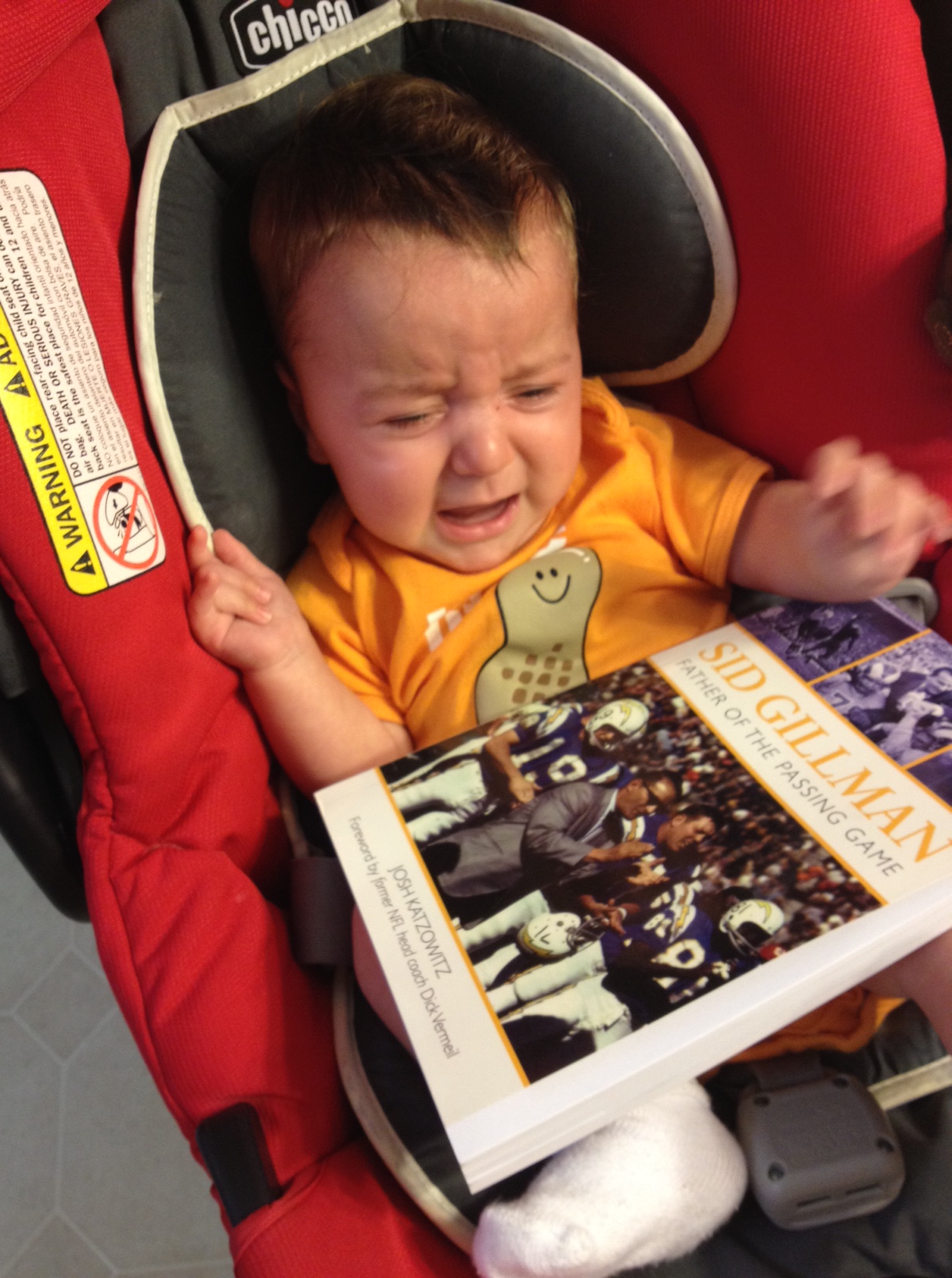
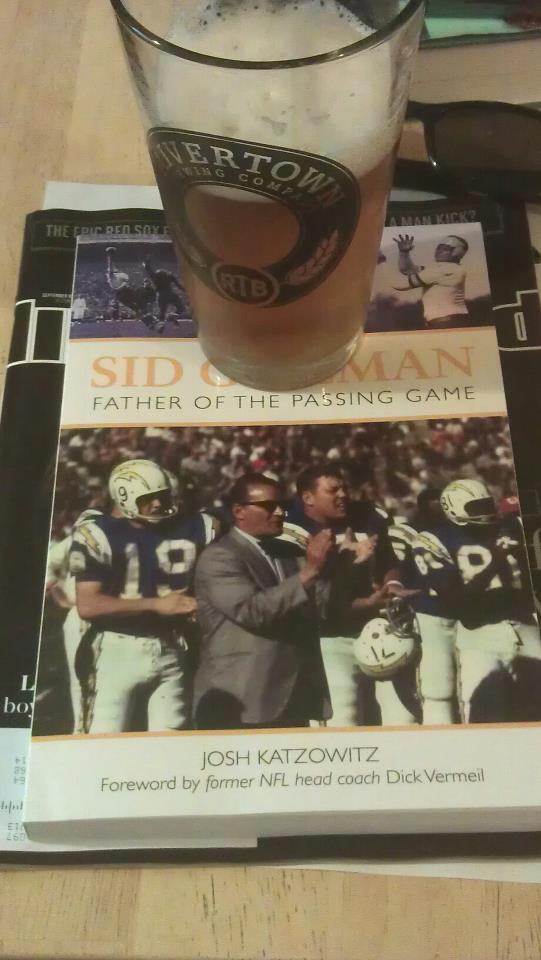
Despite that positive column by my buddy, I’ve had some nasty reviews so far for the book (note: these photos were sent to me by friends).
Witness:
And:
The correct response here: Sigh.
*I have received a couple emails today that tell me the story about Sid Gillman and the Ohio State coaching job is absolutely true. People hearing it from people who heard about it from Sid himself.
Like I wrote in the book, even though it wasn’t covered in the press at the time or since, the story, in my opinion, probably is true.
When I first decided to write a book about Sid Gillman, I knew he was what my grandma Essie would call “a character.” When you’re writing a biography, that kind of unique personality is essential. Sure, Gillman was one of the most innovators in pro football history, but you can’t spend 300 pages solely discussing the fact he’s the only person that resides in the pro and college football halls of fame or the intricacies of his vertical offense or why the 1959 season with the L.A. Rams went so badly awry.
He can be a football wizard, but in order to possibly write a compelling biography, he can’t be boring.
No, he has to be the first coach to room his white players with his black players, he has to be the first pro football coach to spring a team-wide steroids ring, he has to be a bastard, he has to be a sweetheart, he has to be a family man who spends most of his time watching football film. He has to be a contradiction and an enigma. He has to be the kind of guy who can inspire hatred and love and wonder and annoyance in the same conversation with the same person.
For better and for worse, he’s got to be a character who can carry a book.
And it helps if he has the kind of wife like Esther.
I never met Sid, who died in 2003, but I almost had the chance to meet Esther.
In doing research and interviews for my first book, Bearcats Rising, I spent some time with a charming former University of Cincinnati football player and a city of Cincinnati icon named Glenn Sample. Since Sample played for Gillman in the early 1950s and because he loved the Gillman clan, he kept in touch with Esther, even 60 years after they first met. Sample told me that they exchanged Christmas cards – actually, the same goes for former UC player Nick Shundich, who actually lent me a few of those holiday mementos while I researched this book – and while I interviewed Sample about Sid (long before I thought about writing a book about him), he told me he would send me Esther’s address.
The plan for me was to write Esther a letter and ask if I could interview her about her husband. For a woman in her late 90s, she was still remarkably sharp, and her oldest daughter, Lyle, later told me that Esther could have told me enough to fill an entire book because she was still so vibrant.
But, from what I recall, I procrastinated. Interviewing Esther was not really essential to Bearcats Rising, and I never pressed Sample to get me the address. Thing is, when you’re thinking about interviewing a 97-year-old woman, it’s best not to put it off until next week. But Esther didn’t die. Sample did. And with him went the chance to touch base with Esther.
After a few starts and stops, I started researching Sid Gillman in the summer of 2010, and I was dismayed to discover that Esther had died in February of that yea and was buried on Super Bowl Sunday.
Even though she loved sports before she met Sid in high school, she wasn’t into football (though she was a big Red Grange fan). Nope, this was a girl who loved attending hockey games and listening to Jack Dempsey fights on the radio (she sobbed after he lost to Gene Tunney). Sid eventually turned her into a football junkie, and after they were married*, she spent many evenings eating her dessert in the garage while watching game film with her husband.
*The two spent their 1935 honeymoon in Chicago so he could observe a college all-star game at Soldier Field. It rained during the game, and though she used a newspaper as a de facto umbrella, her powder blue wedding dress got soaked.** She also lost her purse that day. Doesn’t get much more romantic than that, am I right, ladies?
**Why she was wearing her wedding dress to a football game, I don’t really know.
She learned football from Sid, but following Sid around and bearing his children weren’t the totality of her life. Esther also loved fashion and going out on the town to mingle with strangers and friends. She loved meeting people, learning about them, making them feel comfortable in her presence. One of her daughters called her another Jackie Kennedy. She was a housewife, but only in the loosest sense of the word.
“This has been my career,” Esther said in 1996. “These are my people. At first, you have to understand. There has to be love to begin with. And understanding. Sid made it very easy for us to love football. He brought it to the family, but he didn’t force us. He made it so interesting for us by bringing film home and teaching us this play and that play. … I loved doing it. It’s an old-fashioned phrase, but I think we were a happy family, and I think that contributes to his success. The man can’t do it alone and the woman can’t do it alone. I didn’t do it because I was supposed to do it. You do it because that is the way to do it.”
One of my most favorite discoveries in my research was finding her recipe for what Sid’s Cincinnati players called Jewish Spaghetti (“It was the hottest stuff in town,” Shundich said). Starting when the two lived in Granville, Ohio, Esther took it upon herself to host Sid’s college players for huge spaghetti dinners. It fostered a sense of family, and it gave the Gillman’s a good excuse to use their window screens as pasta strainers (hopefully, Esther sterilized them beforehand). Anyway, I discovered her recipe for the spaghetti sauce in one of the multitude of newspaper articles that had been written about Mrs. Sid Gillman, and I gleefully put it in the book. It’s irrelevant to the larger story, but that tiny detail has made me happy ever since.
Esther was gorgeous when she was young, and she grew up to be a very handsome woman. In some ways, I fell in love with her during my research and writing, and I talked to a number of people who felt the same way.
“She was an angel,” said Dan Pastorini, who played quarterback for Sid in Houston and had an, um, somewhat love-hate relationship with him. “She was the soft hand in that whole deal. She knew everybody’s name. She knew every player and every player’s girlfriend. She was like the den mother. To put up with that guy for that many years, she had to grow wings.”
Damn, I wish I could have met her. Her kids were great to speak with, but getting to Esther would have been akin to interviewing Sid (mostly because she would have been a better interview than Sid). I’m sorry I didn’t get the chance. And I’m sorry I didn’t follow up with Sample.
Because even though Esther was basically a football wife and mother, she was exceptionally versatile and interesting. She was, at her very core, a character who could carry a book.
The letter below fills me with pride. And makes me a little sad. And makes me excited for the kids. And me. And my free time. But also a little lonely.
Yes, I have mixed emotions about the twins finally heading off to preschool.
Dear Children and Parents,
First of all….WELCOME! I can’t tell you how excited Ms. M and I are about our 2012-2013 class!!
We have been working very hard all week getting your child’s room ready and planning for an (sic) great year of fun and learning.
With the first day of school fast approaching don’t forget that this Friday morning from 8:30AM-10:30AM is “Meet the Teacher”.
Ms. M & I will be on hand, eager to meet you and your child as well as answer any questions you might have in regards to the upcoming school year.
Also, I have set up this e mail especially for the class and will be checking it frequently so please feel free to send us an e mail with any questions or concerns throughout the school year.
Can’t wait to meet everyone and we hope to see you all at “Meet the Teacher” on Friday!
Again, WELCOME! 🙂
Best,
Ms. R
Tuesdays and Thursdays around the ol’ homestead now will be just a little lonelier.




 Josh Katzowitz - Sports Writer/Author/Editor