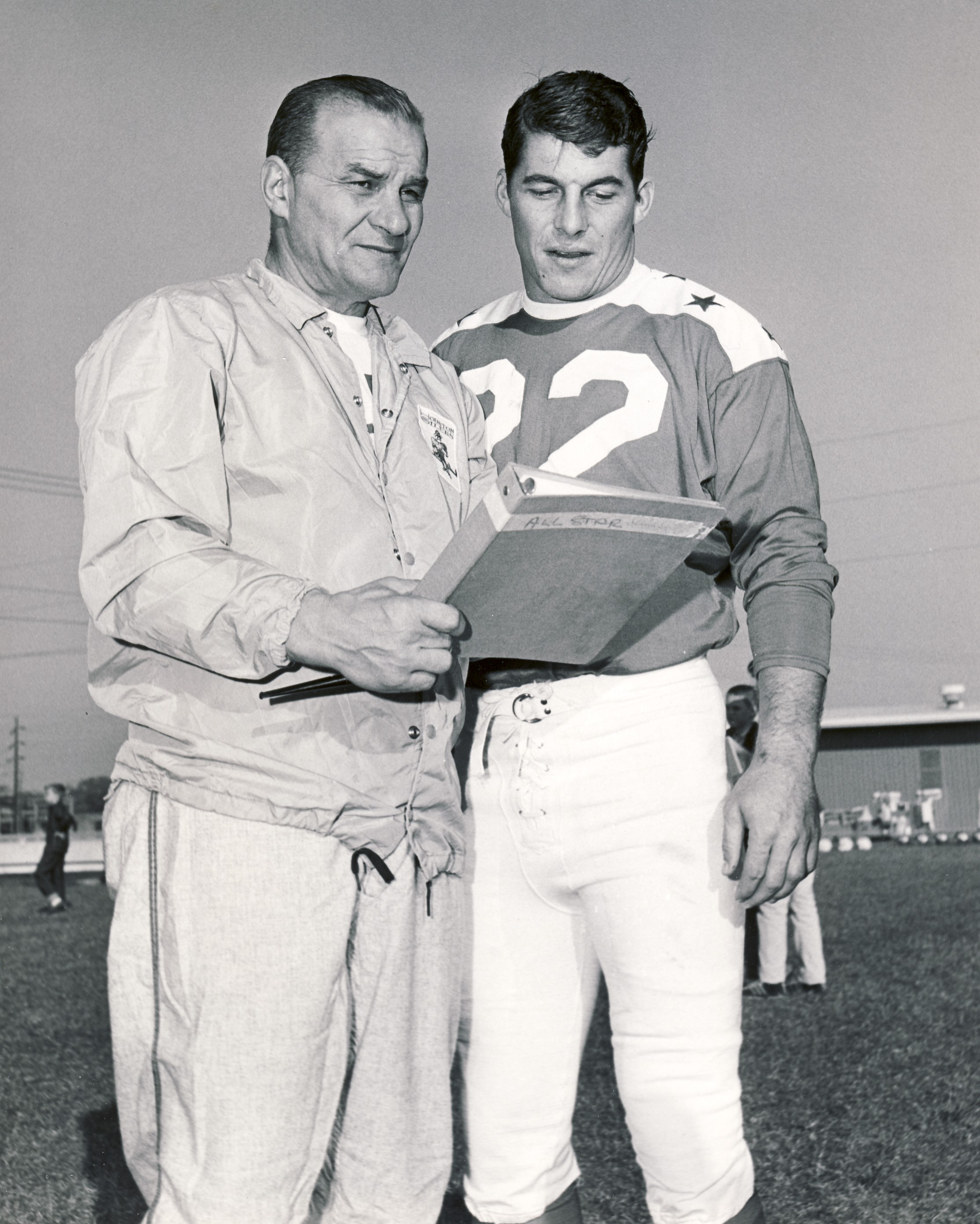
UPDATE (Feb. 20; 11:27 a.m. CT): The guy on the right has been confirmed as Keith Lincoln by Keith Lincoln himself. Still not exactly sure of the year, but the best guess is probably the AFL All-Star game after the 1965 season. Thanks to everybody for playing along.
———-
The man on the left is Sid Gillman, the subject of my latest book. I have no idea about the guy on the right. Does anybody know him? This picture comes from the Gillman era in Houston — so, we’re talking 1973 or 1974. If you get me the right answer, I’ll put you in the acknowledgments section of the book when it comes out this summer and I’ll praise you for the rest of eternity.
INDIANAPOLIS — When the PR guy came by my table in the Super Bowl media room the other day to announce that a press conference discussing concussions and a new way to help decrease them in youth football players would begin in 45 minutes, I was hesitant to go.
I hadn’t eaten lunch yet, and I knew this kind of presser would take at least 45 minutes (at best). Then, I’d have to transcribe the tape and write a post and it was Friday of a long Super Bowl week and I was tired, and, well honestly, it seemed like kind of a hassle.
But the issue of concussions and chronic traumatic encephalopathy fascinates me, and so I went to hear the new ideas espoused by former Harvard football player/WWE pro wrestler Chris Nowinski, Colts center Jeff Saturday and former NFL linebacker Isaac Kacyvenski. And I was glad I went, because I wrote this piece — what I consider to be the most important story I penned all week.
But I still don’t feel like there’s much interest in stories like this. Why? Because there were about six or seven reporters in the room for the presser. Do you know how much press is here this week? Thousands and thousands from all around the world. The fact only six or seven thought this concussions announcement was newsworthy represents the public’s interest in this matter. Players, I think, don’t care much about this issue, and neither do the fans.
When I walked in the small conference room on the first floor of the JW Marriott about two minutes before the start time, the Los Angeles Times’ Bill Plaschke — who penned a fantastic column — told me that when he showed up and nobody else was around, he thought he might be the only journalist to cover the event. No, eventually, I walked in and so did the Boston Globe and the Associated Press and the Toronto Sun and USA Today.
There might have been a few others. After Nowinski made his opening statement, here’s what I asked (and I think this might be the biggest problem with the concussion discussion): It seems that not many people care about this issue; are you fighting a perception battle to get people to care?
“The awareness of the last five years has exploded, but it’s certainly not where it needs to be,” he said.
It’s time to start ramping up this website again. It’s time to start posting. It’s time to start promoting. Now that my book is nearly finished, I can finally tell you that the subject matter is the fascinating Sid Gillman, the father of the NFL’s modern-day passing offense. After working on this tome for about 18 months, it’ll finally be out this summer.
I literally have about 25 more words to go, but I haven’t yet figured out how to write the ending of the book. I have some ideas, but can’t figure out the right combination of words. It’ll come … hopefully, soon.
And then, the full-fledged Gillman-mania will begin.
The last time I saw Conrad Fink, I walked into his office while making a quick visit to the University of Georgia, and I stayed for probably 10 minutes. At that point, I could feel him wanting me to get the hell out of his office. He was a busy man, he had too much wisdom to impart on those journalistic students who committed daily atrocities. He couldn’t talk much about the past with a former student, because he had too many damn edits to make in the present.
I said my goodbye, shook his hand and walked away. This was probably 2002, so I haven’t seen Fink in about 10 years. I don’t remember much of our last conversation together, but I have never forgotten – nor will I ever let go – of the lessons he taught me.
He was the biggest influence in my journalistic life and my biggest mentor. He accomplished goals I can only dream about. He was a longtime Associated Press writer who traveled the world, told the biggest stories, went into management, worked as a professor and became a mentor for many of the journalism students that passed through the UGA Arch.
If you didn’t get to know Fink as a journalism student at UGA, what the hell was wrong with you? If Fink didn’t know you, why were you even bothering?
On Friday, after a 20-year battle with prostate cancer – a fight I was sure he was going to win – Fink died* at the age of 80.
*He would not have been pleased with me for burying the lede of this post.
He was important enough to me (that, or I realized the importance of needing every ounce of Fink I could imbibe) that I took all five of the classes he taught at UGA. My duties at the student paper, the Red & Black, oftentimes made it impossible for me to turn in assignments on time (or to make it to his classes at all). He understood that and he appreciated the students who recognized the importance of apprenticing at the student paper, but he also knew when it was time to bear down on me.
In two separate classes, he sent me the following note tapped on his ever-present typewriter: “Mr. Katzowitz, March 1 is semester midpoint. I recommend you withdraw from this course. I don’t think you can earn a passing grade in the time left.” The first time he gave that to me, it scared the shit out of me, and somehow, I willed myself to pass that class. The second time I got the note, I knew it was him telling me to start doing the work. In both classes, he gave me an ‘A.’
Sometimes, I disappointed him, especially during my senior year when I, as the paper’s sports editor, wrote a weekly football picks column that was sophomoric and disgusting and, ultimately, unfunny. I recently reread some of those columns, and I was embarrassed for my 21-year-old self. But Fink also understood the need to allow his students to grow. He said his piece, and when I ignored him and continued writing the column, he left me alone.
***
Fink was famous on campus for a few things: No. 1, his eyebrows. His bushy, bushy eyebrows that were almost impossible to believe. It was the first thing you noticed about him. But there was also an elegance to his eyebrows. They weren’t necessarily distinguished, but they also weren’t sloppy. They were Fink, and really, that’s the only description I can offer.
No. 2, the way he opened a vein before reading a student’s paper or article and then bleeding all over it. His red pen was brutal, and even on assignments that were well-received by Fink, he still destroyed each attempt with that damn red pen. He was to editing as Norman Bates was to women in the shower.
No. 3, his most famous in-class advice was, whenever you were writing a story, to always think about the little old lady from Keokuk, Iowa. In other words, explain it as simply as possible so that even an elderly woman in the Heartland could understand. That line made for great fodder – and no doubt, it’s a true idea – but that’s not really what I think about every day.
No, what I remember most is what he taught me about self-editing. After hashing out your story and rereading it once for editing purposes, he said, get up from the computer (or, in his case, the typewriter) before sending it to the copy desk. Take a breath, get your eyes focused on something else before you return for one last edit, slow down if even for an instance. His exact advice, in fact, was to “go to the john.” And whenever I was covering a late-night Cincinnati Reds game or finishing up my University of Cincinnati basketball gamer or banging out a Roger Federer piece for the NY Times, before I hit send, I always got up and went to the john. And yes, usually I thought about Fink while doing so.
I remembered his tales about his first newspaper job at the Daily Pantagraph in Bloomington, Ill., and when I was on assignment covering a University of Cincinnati basketball game at Illinois State in Normal, not too far from Bloomington, I procured a copy of the Pantagraph. I sent him a note on Facebook telling Fink that I was thinking about him.
That’s the other thing about Fink. He never stopped evolving. He signed up for Facebook and instantly was connected to all his admirers. He was an old-school newspaper writer, but he also understood where the Internet was taking journalism. Did he understand the consequences on the newspaper business when I was in college? No, I don’t think so. He never thought newspapers would begin to become irrelevant. I think he was wrong about that. That might be the only thing about which he ever was wrong.
Yet, as evidenced by the clip below, it didn’t take him long to get it right.
Ah, I wish Fink had gotten on Twitter. I would have loved to hear about him washing his dog.
***
We kept in touch. Well, I kept in touch with him, and usually, he responded shortly and sweetly.
In May 2007, when I still lived in Cincinnati and was planning my itinerary for my brother’s wedding in Atlanta, I sent him an e-mail saying I would make a day-trip to Athens if he was around. He wrote back: “katzowitz, you rascal, you voice from my past! delighted hear from you. unfortunately am at my upstate ny farm clearing my head of undergraduate journalistic misdemeanors and felonies. try me again in late august. Fink”
On Feb. 29, 2008, I sent him a link to the most-impactful story I’ve ever written, a New York Timespiece that made the sports front about a disabled wrestler from southwest Ohio. In the e-mail, I wrote, “How many of these bylines do I have to get before I get a free copy of your sports writing book?” He wrote back: “free? you rascal! i should be charging you. Fink”
When I wanted to send him a copy of my first book, Bearcats Rising, I asked for his address so I could send him a package, and he wrote back, “doesn’t tick, does it? fink.” In the acknowledgment section in the book, I penned, “I wouldn’t be where I am today if it wasn’t for his guidance and help. He is my mentor, and even though he still refuses to send me any of his books unless he has my personal check in hand, I’ll always be grateful to the ink-stained wretch.” In response, he sent me this message: “katzowitz: enormously flattered by your acknowledgment of me in your book, which i will delight in reading. thanks, and great good luck. fink”
That was the last time we corresponded.
[UPDATE: Just got this e-mail from a former Fink-acolyte who overlapped with me at UGA: “He’d be proud of you, Josh. I know when I saw him in November he asked for an update on you.”
I can’t tell you how good that makes me feel.]
He imparted so much knowledge on all of us, but he was not overly generous with his compliments, maybe because we all so badly wanted his respect. You know, he always talked about wordsmiths, those who could craft a story into a journalistic masterpiece. Usually, he was referring to the Atlanta Journal-Constitution’s Steve Hummer when he used that term, but he probably harkened back to the days of Red Smith and Jim Murray. I once asked him if he ever thought I would be a wordsmith, and he said he believed that I would. It was, without a doubt, the nicest thing he ever said to me.
Fink, I’m still working to that goal, and I’m still remembering everything you taught me. I’m so sad I never made another visit to Athens to visit. But I’ll never forget you – not your bushy eyebrows, not your red ink, not your passion for journalism. Fink, you were more than a professor to me. You were my hero. And I, along with your students, am going to miss you greatly. Tonight, the little old lady from Keokuk, Iowa is weeping.
In the dark night, with the runway lights illuminating little stretches of land and with airplanes screaming overhead, I searched the crowd of people waiting for the rides that would take them away from the airport.
Finally, I found her—a pretty brunette with a Baby Bjorn carrying another pretty brunette. I hadn’t seen my wife in a week, and as a result, I hadn’t seen my twins.
My wife came home the other day from the grocery store, and as I peered inside one of the recyclable bags, my eyes grew wide.
“They were on sale,” she said by way of explanation, anticipating the lift of my eyebrows. “It was buy one, get one free. Plus, they won’t last very long.”
I slowly pulled the tiny jars from the bag, and I began to stack. And stack and stack. There were peas and carrots. There was squash. There were bananas. There were fruit mixes and vegetable-pasta mixes. And there were a ton of them.
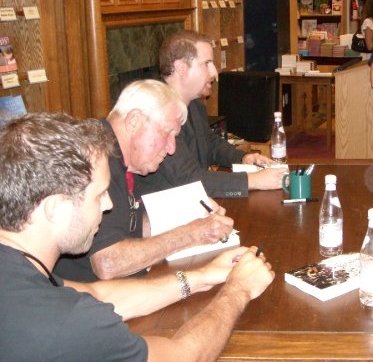
(L-R): Dustin Grutza, Don McMillan, Josh Katzowitz
I called the number one Sunday morning – on Jan. 11, 2009 to be exact – and the 87-year-old man who lived in Cleves, Ohio, answered the phone with a pleasant hello.
We proceeded to talk non-stop for the next two hours. I hadn’t planned to be on the phone with him that long – I figured an hour, tops – but he was such a good storyteller, had so many interesting memories to recount, that he took up most of the rest of my day.
His wife, Patricia, was by his side the entire time, and every once in a while, she’d whisper to him to remind him of something from days long gone. At one point, she actually took the phone away from him and started answering my questions herself.
She was Patty – a red-headed Irish girl – and she was the love of Don McMillan’s life. It was obvious then on the phone. It was obvious a few months later when I met Don and Patty face to face at the opening kickoff/book signing for Bearcats Rising – my first tome.
When my publisher and I were trying to figure out who we should invite to be guests at my first book signing – who would sign books along with me – we wanted to go with a current player (Dustin Grutza) and we wanted an older guy, a guy who had been around the program a very long time and who had a long-reaching perspective. Since I had such a great conversation with Don, we asked him if he could make it. He said he’d be glad to attend.
I was honored to have him there with me, and he obviously was proud to be there as well, answering my queries during the free-for-all discussion between the audience and the three of us that led into the actually signing.
Don was a guy who had much to say.
He had served in WWII on the aircraft carrier San Jacinto, and he worked underneath the runway in the catapult, which basically shot the airplanes off the ship and into the sky.
“I can remember when they told me I was going to be a catapult aboard the carrier,” McMillan said, “and I asked, ‘Would you please tell me what the hell a catapult is.’”
Many years later, he would meet George H.W. Bush – one of the fighter pilots on the San Jacinto – and when the two saw each other, Bush asked, “You shot me off, didn’t you?”
The San Jacinto was a magnet for Japanese kamikazes. Time and time again, the crew would see enemy pilots attempt to destroy the flight deck by crashing their planes into the ship, but they never finished the mission. But those guys got close. Close enough to where, one day, McMillan found a severed finger on the catapult track. Another day, he looked inside the gun mount and saw a lifeless Japanese body who looked ready to jump out and continue the fight.
Said McMillan: “There was a catwalk all the way around the flight deck, and when you stand on it, you’re shoulder high to the level of the flight deck. When all that commotion is going on, you want to jump over the side of the boat, for crying out loud. That’s the last resort. You don’t want to do it. But you don’t get used to it, no matter how many times they came after you. When we started hitting the Philippines, that’s when they started coming. That was their last hurrah. They knew they were going to lose the war.”
After the war ended, McMillan, a 24-year-old freshman, played quarterback at the University of Cincinnati. More than 60 years later, he told me his best tales and gave me so much help for my first book. He told a fantastic story, and from what I’ve gathered, he was a fantastic man.
Today, one of his old teammates told me McMillan died last month at the age of 89. He left behind Patty and a wonderful, full life – he was a former high school football coach in Northern Kentucky who impacted many, many young lives – which he shared with his greatest love. When I heard the news, I went to the copy of Bearcats Rising I keep on my bookshelf, the one where I gathered signatures of all the former UC players who signed with me at various appearances, to look at what Don wrote.
Dear Josh, What a great pleasure it was to be with you and Dustin. You made an old man feel young again. God Bless, Don McMillan
Don, thank you, my friend. The pleasure was all mine.
Check out this blog post from one of my favorite writers, Esquire’s Chris Jones.
These three grafs pretty much sums up what Jones is talking about when he’s discussing book-writing:
I get a lot of e-mails, and the great majority of them have something to do with writing and how to do it for a living. Strangely — or at least it seems strange to me — a lot of people seem to think they can write a book. Nobody thinks they could start plumbing a house tomorrow; nobody thinks they could sit down first thing in the morning and spay a cat. And yet a lot of people think they can write books. “They’re just words,” someone once said to me.
There’s a story up here, probably more legend than truth. The famed novelist Margaret Atwood was apparently at a party, talking to a brain surgeon. He told her that he was going to write a novel when he retired. “Oh, that’s funny,” Atwood said. “I was thinking of doing brain surgery.”
Book-writing is a mean business. They’re just words, but they’re 100,000 words assembled in some beautiful and logical order to tell a story that keeps a reader plugging along from beginning to end.
I don’t get offended when people say things like that to me – hell, maybe these people can write a book – but to me, it’s not about saying you’re thinking about doing it. It’s about actually putting fingers to keyboard. Bearcats Rising took me about a year to write. I put my soul through the wringer for the final product. I fried my brain so hard on it that I haven’t read the book since it came out in Aug. 2009 (I might never read it at all). But sure, go ahead and write yourself a book. I’d be happy to copy-edit it.
On May 3, 1994, a few buddies and I took MARTA to the North Avenue station, walked west to Georgia Tech’s Bobby Dodd Stadium and prepared for the concert of our lives.
At the time, I don’t think I really appreciated what I was about to witness. I had been a Pink Floyd fan since, probably, seventh grade, and two years later, the final incarnation of the band released what would be its final studio album and gave its final world tour. At the time, I had seen one real rock concert – Aerosmith, with special guest Jackyl! – and I was pumped to see Dave Gilmour, Richard Wright, and Nick Mason (sadly, Roger Waters had been out of the Pink Floyd picture for about a decade).
And it was incredible. Though I really only knew the Pink Floyd material that EVERYBODY knows (Dark Side, Wish You Were Here) and the last couple of new albums, it was incredible. I didn’t recognize “One of These Days” or “Astronomy Domine,” because I wasn’t familiar with those portions of Floyd’s catalog (really, you have to be a pretty intense fan to own “Piper at the Gates of Dawn.” I do, now.)
Sixteen years later, I remember the fog rolling into the stadium after a rainy day, making the night all the more surreal. I remember the older folks behind us asking us to sit down for the first act. I remember the Bill Clinton look-alike blowing the sax on “Us and Them” (Clinton was, in fact, in town that day). I remember “Time” and “Money” and “Shine On You Crazy Diamond.” I remember the unbelievable light show.
A small taste here.
And here:
Tonight, I’ll complete the Floydian circle – or the crazy diamond, if you prefer.
The wife and I are going to see Roger Waters, the only original Pink Floyd member I didn’t see in 1994 (except, of course, for Syd Barrett). He’s celebrating the 30th anniversary of The Wall by playing it in its entirety. All the reviews I’ve read have been stunningly positive. The sound apparently is great, and the entire show (like the original Wall tour, building a Wall brick by brick before tearing it down at the end) is an amazing piece of work.
See part of the spectacle here (when the wall comes down).
I haven’t been this excited for a show in quite some time. Sixteen years later, I’m ready for something just as special as the night I walked into a stadium with a couple buddies and walked out having seen the best show of my life.
I went for a run last night. Well, a run that was interrupted quite a few times by walking. It’s the first time I’ve jogged in, oh maybe, five years, and I’m trying to get back on track.
I used to jog all the time, though I never much liked it. I ran the Peachtree Road Race (10K) thrice in my teenage years, and I was in pretty decent shape. Not now. Now, I’m much heavier than I want to be. So I’ve started eating better, and I’ve begun to exercise.
The past few years, I’ve used our Elliptical to work up a sweat. But even so, I’d always feel a little guilty, like I could do a little more. Exercising while reading a magazine or watching a sitcom just doesn’t seem quite as sporting to me.
This column by Rick Reilly, when he was with Sports Illustrated, always stuck with me. Especially when he writes, “We’re here to sprint the last 100 yards and soak our shirts and be so tired we have to sit down to pee.” You don’t get that feeling by doing 45 minutes on an Elliptical. You just don’t. You can sweat and be tired and feel good about yourself. But you – and by “you,” I mean “me” – don’t push yourself to your limit. You can’t feel your heart jackhammering like a scared rabbit.
I wanted to feel that way again, especially since I’d like to run the Peachtree again next year on July 4.
So, I waited until about 8:30 p.m., so nobody could see my struggles (I figured this wasn’t going to be me at my best), and I went out. Thirty seconds into the nice, easy run, my back was killing me and my legs were heavier than bowling balls (the big-boy balls, not the little kids’ kind). I ran for probably 5 minutes before I was done with the whole running thing. It was a little nippy outside, but my lungs felt like they were breathing in Lake-Placid-in-February air. I kept walking, but clearly, I was a long way from … well … anywhere.
I walked a little. I ran a little. I began to feel better. I began to feel worse. My breathing was the same. Heavy.
Finally, about five minutes from the house, I began to jog for the final stretch. Suddenly and strangely, I smelled the odor which only emanates from a horse. “That’s weird,” I thought to myself. “Where could there possibly be a horse in range where I could smell it? Hmm, I must be having a stroke.” But I pressed on.
Until I could see my mailbox. Where I staggered for the final few steps of my journey. I felt breathless. I felt nauseous. I felt wonderful (not at all, actually). But I did begin to remember what Reilly had written 11 years ago.
I didn’t have to sit down to pee. But I felt wildly exhausted from my 33-minute excursion. I also felt I had made some progress. My heart was really pounding. A single bead of sweat ran down my forehand. This was exercise.



 Josh Katzowitz - Sports Writer/Author/Editor