Will Carroll/@injuryexpert, sports medicine writer

will-carroll-mug1

The only time I’ve talked to Will Carroll was during a rainy night in Louisville when we were trying to watch a Cuban phenom pitch in the minor leagues. That was three years ago, and since then, Carroll has become this country’s most renowned sports medicine writer. In our chat, we discuss how he found his online niche, why he thinks the HGH soap opera of the last five years is the most overblown sports storyline perhaps ever, and how a reporter who deals in injuries builds up his source list.

Plus, we lament our disappointment in how a baseball Hall of Fame voter could actually sell his or her ballot to Deadspin. “It sickened me,” Carroll said.

And on a lighter note, we talked about how his high school car was a Pontiac Fiero (and how badass I thought that was when I was a 10-year-old kid).

(Interviewed 12-1-13)

Mack Williams, animator – formerly of Archer, Frisky Dingo, Sealab 2021

mack-williams-mug1

I’ve known Mack Williams for about 13 years, and I’ve always been amazed by his design skills, and though I’ve never seen a full episode of Archer, he was one of the main contributors for the first few years of that FX show. During our chat, we discussed why people love Archer so much (hint: he said it’s the writing, not the animation), why people of a certain generation still are enamored of animated shows even after they’ve become grown-ups, what exactly the first years of Archer were like, and the logistics of how an episode is made. Plus, he talks about what it was like to meet his idol, Mad magazine co-founder Jack Davis.

And then …

We morph into a conversation about actual journalism where we discuss editorial cartoonists while lamenting the decline of artists who do that on a local level. Plus, we talk about his band, Attractive Eighties Women.

And just because, here are two Attractive Eighties Women videos.

Here is some of what we talked about (and some of what we didn’t).

mack-williams-rundown1

Moving into big-kid beds and embracing what it means

11-20-13 (1:47 p.m.): We had our first parent-teacher meeting of the year with our kids’ preschool teacher, and everything went well. The kids got glowing reviews.

Great news, obviously. But Ms. RM also mentioned that we might want to split up the twins into different classrooms next year when they start pre-K. It’ll be better for them, she said, and she nodded her head solemnly when she declared her opinion.

It might be the best move indeed, and if we follow that route, it’s just another sign that the kids are growing up, away from us as parents and away from each other toward individuality. A step toward their own sense of freedom, where they can open their arms wide to embrace all that’s ahead.

Coincidentally, today is the day the twins’ full-size beds were delivered. One white bed and dresser for Stella in her purple-walled room. One brown bed and dresser for Noah in his blue-painted dwelling.

I spent the late morning disassembling their cribs/toddler beds — a sadder activity than I might have originally thought — and the movers just left. In their wake, they’ve left behind the beds that the kids might use until they leave us for college.

The kids will leave their shared room after 3 1/2 year and finally have some semblance of privacy — something they’ve been talking about lately when they have to use the potty. But do they truly want it? During the past few months, we’ve built up Stella’s impending move from their room into what will become her room. They seem excited to think about the future.

But I worry a little about Noah and how he’ll feel when Stella is no longer there. I wonder if Stella will be bothered by the wind howling that occurs outside her window without the comfort of her brother nearby. I worry if they’ll miss each other and want to rewind to the past. Because, throughout their lives, all they’ve done is share space. A bedroom, a bath, a corner in the NICU, a womb.

Will they find their new independence a pleasure? Or will they be pained by the absence of the person to whom they’re the closest?

Sometimes in our rush to get older we forget that it means leaving behind the people who have loved us all along. Even if they’re just a few feet away, behind a closed door, in the next room.

UPDATE 7:40 p.m.: The kids just discovered their new beds. They are ultra-excited, even though Stella admonished Noah from climbing up on hers.

UPDATE 10:12 p.m.: Usually, the twins will emerge from their bed a few times a night, asking for water or for another hug or for snuggles. We’ve tried to put a stop to that for the past few months with varying degrees of success.

Tonight, Noah hopped off his bed once, trotted into the office and said he wanted to kiss me on the cheek. He did and he bounced back into his room. That’s all we heard from them.

I just checked on the two, and both are in the exact same position — on their back and with arms spread wide. No longer are they bound by the width of their toddler bed. Now, they can spread out and embrace the unknown future. They are no longer stifled by their shared space.

They are now toddlers in big-kid beds, and they are free.

Dayn Perry, CBSSports.com baseball writer

Sports writer Dayn Perry. Photo by Andrew Collings. December 18, 2009.

Dayn Perry is one of my favorite scribes, because his writing harkens back to a time when those ink-stained wretches rode the rails and stashed their bottles of gin inside the desk drawer, screaming “COPY” and “STOP THE PRESSES” whenever it needed to be bellowed.

In our chat, we discuss why his florid-style of writing is so unique, how he got to be a special consultant with the San Diego Padres, and why baseball is such a beautiful sport to write — and to have written — about. Plus, we chat about how perhaps the Roger Maris/Mickey Mantle home run chase in 1961 led to a shift in the way scribes covered baseball (and the way readers think about it) and why author Robert A. Caro is a five-tool writer.

When talking about Perry’s style of writing, here are a few of my favorite examples:

Look at these baseball cards that I just bought; just look at them

Hey look, a bullpen phone

Drinking with Boileryard Clarke

T.J. Simers, longtime L.A. Times/current Orange County Register columnist

tj-simers-mug1

Longtime Southern California columnist T.J. Simers has been acerbic and acidic throughout much of his career, but that’s not how he sees himself. He sees himself as a humor columnist. That’s actually his first goal when he wakes up in the morning — to make people laugh.

In our chat, we talk about how and why he made the transition from the L.A. Times to the Orange County Register, how he built the T.J. Simers world for his readers complete with recurring characters and inside jokes, and why he feels comfortable being completely (and oftentimes uncomfortably) honest with his subjects in the newspaper and in real life.

Plus, he explains why a columnist’s best attribute is survival, and we reminisce about Mike Royko, Jim Murray, and Red Smith.

My favorite Simers quote from our chat:

“Do I cringe at myself sometimes? Absolutely.”

Here are some of the subjects we talked about (and some we didn’t).

tj-simers-rundown1

Becky Friedman — story editor, head writer of Daniel Tiger’s Neighborhood

becky-friedman-mug1

Becky Friedman has been one of my most favorite podcast guests so far. No. 1, she’s not a sports writer. No. 2, my kids love her work. Friedman, you see, is the story editor and head writer for the animated PBS kids show, Daniel Tiger’s Neighborhood — which serves as sort of a sequel for the characters who resided in the Neighborhood of Make Believe in the old Mr. Rogers Neighborhood show. If you haven’t seen the show, head over here to introduce yourself to Daniel and friends. If you have children of a certain age, you might know exactly what I’m talking about.

In our discussion, Friedman and I talk about why all those damn children’s songs gets stuck in our heads, why the writers don’t aim the show’s material at adults, and how everybody thinks they could write a children’s book or TV script. Plus, she runs us through how an episode gets made and why Fred Rogers’ comforting words and legacy continue to impact us today.

My favorite quote from Friedman: “Preschoolers don’t give pity laughs. if they don’t like something, they’ll get up and walk away.”

Here’s some of what we talked about (and some of what we didn’t).

friedman-rundown1

Reporting and writing about death

death-rundown1

With the recent events surrounding the tragic death of Adrian Peterson’s son – and the way the reporting of it was handled by the media – I wanted to get the take of three journalists I respect and discuss how they deal with reporting and writing about someone who has died. Thus, I talked with Sean Jensen – formerly of the St. Paul Pioneer Press and the Chicago Sun-Times and the one to break the story that the critically-injured boy was actually Peterson’s son. I also brought in SI.com’s Doug Farrar and New York Times bestselling author Jeff Pearlman, who vehemently disagreed that week through social media on whether sending condolences in a blog post about the news was appropriate for a journalist (here was Pearlman’s blog post on the matter).

With Jensen, we talked about his process for breaking this particular story, what he will and will not ask while reporting on a topic as sensitive as this, and how high we should be jumping to be the first to scoop the death of a famous person.

With Farrar, we discussed his process on writing about the Peterson story, why some fantasy football writers would try to pimp their sites during the ongoing story, and why Farrar might or might not continue to send out his thoughts and condolences when writing a similar kind of piece in the future.

With Pearlman, we gathered his thoughts on why you never, ever, ever write your condolences on a news piece about somebody’s death, how he reported on the death of a former college basketball player two days after 9/11, and whether it ever would be appropriate to try to contact Adrian Peterson during that time to find out information.

John Koblin, Deadspin.com writer

koblin-mug1

Coming off the Oklahoma State investigation by Sports Illustrated and by the media’s subsequent investigation of SI, we talk to the fantastic John Koblin, who writes for Deadspin.com and is one of the top media critics in our field. In our chat, we discuss media-on-media criticism in the Twitterverse and whether it’s helpful for the greater good, and we chat about whether it’s OK to pay sources for information and other incriminating evidence. Plus, we talk about the state of Sports Illustrated and how Deadspin broke the Manti Te’o story.

Also, we discuss how Koblin investigated and broke the a story about how an ESPN.com columnist named Sarah Phillips was scamming readers. Here’s that story from Koblin.

Here’s some of what we talked about (and some of what we didn’t).

koblin-rundown1

Bill Rabinowitz, Ohio State football writer/author

bill-rabinowitz-mug1

I got a phone call from Bill Rabinowitz many months ago, and during our conversation, he asked about what it took to write a book in a very short window of time. Despite my somewhat-discouraging words, he went off and wrote a wonderful book about the 2012 Ohio State team, Buckeye Rebirth: Urban Meyer, an Inspired Team, and a New Era at Ohio State.

In this podcast episode, we discuss his process in getting a book deal done and an actual tome written (where he had to write 80,000-plus words in about a four-month span), what it was like dealing with Meyer on the project, and if you can actually make money in the world of book publishing. Plus, we detail his rise from selling knives to where he is now and how he balances a busy beat (and writing a book) while spending time with his family.

Here’s some of what we talked about (and some of what we didn’t):

rabbi-rundown2

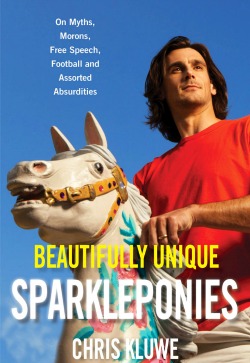
Chris Kluwe: Book author/NFL punter

chris-kluwe-book-cover-09242013

It’s a big week for the Mightier Than the Sword podcast and Chris Kluwe. We booked our first professional athlete for MTTS to talk with us about his writing skills, and for Kluwe, he made history as the first person ever to speak on this podcast after appearing on Conan AND the Ellen how. Really, it’s a big week for everybody involved.

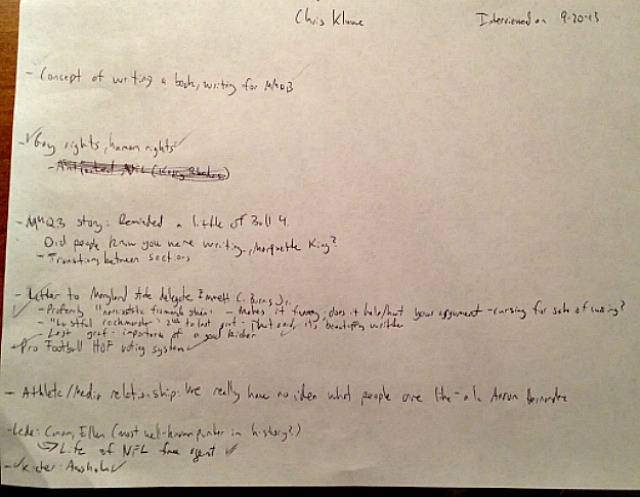
This week, Kluwe and I talked about how he’s adjusting to life as an in-season NFL free agent, how his profanity is so beautifully written, and why he uses that graphic approach to draw attention to his underlying point. Plus, Kluwe theorizes on the idea of “truth,” why he bothers dealing with Internet hate and how he would change the Pro Football Hall of Fame voting process.

Warning: the language in this podcast is more explicit than normal.

Since we talk about this piece quite a bit in the podcast, here was Kluwe’s letter to Maryland state delegate Emmett C. Burns.

Also, here’s his piece for themmqb.com on his punting battle with Marquette King.

Here was some of what we talked about (and some of what we didn’t).

chris-kluwe-rundown1