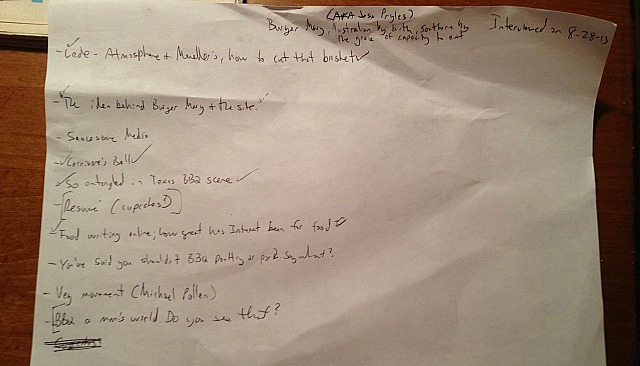
For the first time, we interview our subject live and in person, and we had the ideal guest – the talented Burger Mary (AKA Jess Pryles). She’s Australian, she’s a social media maven and she blogs about BBQ (and from personal experience, she can cut a mean slice of brisket). This week, we talk about why an Australian heavy metal VJ fell in love with the romanticism of the American South, particularly New Orleans and Austin.
Plus, we ruminate on how she got entangled in the BBQ scene in the U.S. (and what the food scene is like in Australia), why she’s always gravitated toward the so-called male-dominated fields, and how to eat healthy while ingesting beef ribs and BBQ sauce. Plus, I get to tell my Roger Federer/salad dressing story.
Here’s some of what we talked about (and some of what we didn’t).
This week marks the second of two episodes in which five writers and I discuss the art of asking questions. Today, we’ll entertain NY Times best-selling author Jeff Pearlman, Cincinnati Enquirer beat writer Bill Koch and Columbus Dispatch beat writer Bill Rabinowitz (last week, in case you missed it, we spoke with Tampa Bay Times enterprise writer Ben Montgomery and CBSSports.com national columnist Gregg Doyel).
With Pearlman, we talk about the John Rocker story, whether Pearlman thinks now he should have given Rocker the chance to take back his controversial comments before he published them in Sports Illustrated, and about his approach to asking the tough questions. Koch, meanwhile, talks about how a daily beat writer approaches the question-asking when he sees the same coach a few times per week and why humor is one way to build a rapport with those he covers (he also tells some fantastic stories about Tennessee coach Butch Jones). Finally, Rabinowitz talks about why sometimes the best question to ask is, well, silence.
This week marks the first of two episodes in which five writers and I discuss the art of asking questions. Today, it’s Tampa Bay Times enterprise writer Ben Montgomery and CBSSports.com national columnist Gregg Doyel, and next week, we’ll entertain author Jeff Pearlman, Cincinnati Enquirer beat writer Bill Koch and Columbus Dispatch beat writer Bill Rabinowitz.
Montgomery tells a fantastic tale of how one journalist slowly adds details to a story about a hero by the way he approaches the question-asking, while Doyel talks about why it’s important not to be scared to ask the challenging questions (“Fear is weakness,” he says). Also, Doyel and I chat about this:
Finally, a female guest, and it’s a good one. Colleen Oakley is a novelist, former editor for Marie Claire and freelance writer who’s penned pieces for the New York Times and Ladies Home Journal. We’re trying something a little different today. Since Oakley is at the beginning of the process for writing her third novel (and hopefully the second to be published), we’re going to check back in with her occasionally during the next year or so as she describes the highs and lows of writing 100,000 words that might or might not be publishable one day.
In the first installment of the Colleen series, she introduces herself, and we chat about why she’s comfortable writing about her sex life, whether she tries to be funny in her prose, what it’s like to write for women’s magazines and how she reacted to receiving a death threat. Plus, why does she write so damn much about eating pancakes and why she does she geek out so hard about perfect analogies?
If you have interest in how somebody writes a novel, Oakley is the one who can answer that query.
For those who want to read Oakley’s work – and some of what we talk about in the podcast – here’s her New York Times piece on An Agnostics Guide to Marriage and her Marie Claire feature on participating in a 30-day sex detox.
Here’s some of what we talked about (and some we didn’t).
The impetus for this podcast was the recent decision by my former CBSSports.com colleague Mike Freeman to take a job with Bleacher Report, and Michael Schottey was the guy who could explain that move and where the website is going. In our chat, we talk about whether the perception of B/R simply being a free content mill will ever change, whether website aggregators and content-providers can have a symbiotic relationship, and why his site doesn’t want its writers breaking news. Plus, we discuss his original goal of becoming a Lutheran pastor and why Schottey feels like God is OK with his ultimate decision to write about sports.
Here’s some of what we talked about (and some we didn’t).
With the recent launch of Peter King’s new NFL-centric website, theMMQB.com, we sat down with Greg Bedard, formerly of the Milwaukee Journal-Sentinel and the Boston Globe, to discuss the idea behind the site and its future goals. In our chat, we discussed why a Little League team from south Florida was so important to Bedard’s career, whether writing game stories for national websites is worth it, and how misguided predictions can live on forever. Plus, we have an in-depth discussion about his use of film work that allows him to be better-educated about football, and we talk about why Nick Saban would dare throw f-bombs Bedard’s way.
Here’s one of the spreadsheets Bedard uses when he watches film:
And here’s the rundown of what we talked about (and some of what we didn’t).
Montgomery is an interesting character, and we had a fascinating in-depth conversation about his craft and about how we can improve the newspaper industry. In our chat, we discussed his approach to covering the George Zimmerman/Trayvon Martin trial, why he live-tweeted his father’s wake and funeral, and how he originally wanted to run his grandfather’s farm.
A quick homework assignment. We discussed two of his stories in depth, so before you press play, if you’re so inclined, read these pieces: 1) How most of the witnesses to the Martin shooting were actually watching TV during the struggle with Zimmerman, and 2) Montgomery’s return to his home state of Oklahoma after the mammoth tornado in May 2013.
Seriously, if you want an enlightening discussion about how to write the hell out of some stories, let Montgomery’s soothing tone educate you.
In case you were wondering about the song Montgomery talks about, here’s Steve Earl’s “Someday.”
And here’s the rundown of what did (and didn’t) talk about.
.@NFLosophy, AKA Joe Bussell, is one of the more fascinating Twitter characters of the year. He joined Twitter as an anonymous NFL expert who dropped a ton of seemingly-credible knowledge, and it left us wondering whether he was a phony and when or if he would disappear once he found a new job. He recently shed his anonymity and declared himself as a real person. In our chat, we talk about why he started his anonymous Twitter feed in the first place, if shedding the mask will help him for future NFL employment, and what his operations job with the Buccaneers actually entailed. Plus, we discuss why NFL teams who have to play in London suffer through such a massive undertaking and why Bussell, who wasn’t involved in the Buccaneers personnel department, was fired along with the rest of the Raheem Morris-led coaching staff after the 2011 season.
Here is some of what we talked about (and some topics we didn’t) as I took notes during the interview.
Trent is one of my best friends and the perfect guest to begin this podcast. In our chat, we talk about working a baseball beat – and why his day is so damn long – why the Cincinnati Post was a great paper to work for even though we knew it was going to die at the end of 2007, and how he handles anonymous criticism from what could be the very vocal minority. Plus, why would he go from working at a national website to a local newspaper?
I’ve been thinking about this idea for awhile. Maybe six months or so. I’ve turned it over in my head. I’ve talked to trusted friends and colleagues. I’ve had to go through airport security with a phallic-looking Snowball microphone in my luggage. I’ve thought about what kind of podcast I’d want to hear every week.
Hopefully, I’m starting one that you’d like to ingest as well – thus, the mighty Mightier Than the Sword podcast has been born.
I’m a sports writer, but this isn’t necessarily going to be a sports writing podcast. In fact, chop off the first part of the phrase. It will be a podcast about writing. And about writers, about their backgrounds and about the charcoal-to-bark, pen-to-paper, digits-to-keyboard, fingers-to-smartphone-screen world in which I love to live.
I didn’t care about creating another podcast that broke down the latest big game or previewed the next one upcoming.
I’m more interested in the type of podcast that involve conversations about why we love to do what we love to do. In my case, that’s writing and journalism. So, let’s discuss the craft of writing – why we put this paragraph here instead of two grafs lower, why we thought that line was more effective as a lede rather than the kicker, why you ask the questions you do.
Let’s pontificate on the state of journalism and how we can all do it better. Let’s showcase the journey a top writer took to get where she is or daydream with the recent college grad about where he wants to go.
A couple things you can expect out of the Mightier Than the Sword podcast.
1) I’m a journalist. The story isn’t usually about me. That’s why I’ll mostly refrain from monologues before I introduce my weekly guest. We’ll fade out the sweet intro sounds of my favorite Athens, Ga., band, Asa Nisi Masa, and go right into the conversation with the guest.
2) We’re going to be as timeless as possible. I don’t want somebody who discovers this podcast two years from now having to wade through analysis of games that are 750-days old. The goal is to talk about topics that will matter in a month. Or a year. Or five years. That, to me, leaves a weighty imprint on this podcast that won’t ever dissolve.
3) I want listeners involved. I want to hear your questions, and I want to hear about your suggestions for interesting guests. This won’t be a democracy, but I promise to be a benevolent king.
So, that’s that. If you want even more of an introduction or to listen to more details about my background and about my goals for the podcast, take a listen. And, in the months ahead, keep listening and listening and listening to those stories behind the storytellers.
This week’s guest (7-24): C. Trent Rosecrans, Cincinnati Enquirer, Reds beat writer






 Josh Katzowitz - Sports Writer/Author/Editor