Sid Gillman and his love of jazz

When I first got into the book-writing game, I thought you could throw all your research, all your interviews, all your written words into your masterpiece of a tome. And there it would stick, all your thoughts (every single one) for all the book-reading public to consume.

I had all the space in the world, right? So, I figured, why not mash all the good stuff in there? Somebody gave me an excellent quote that didn’t really fit the context or the narrative? Shoehorn it in. I discovered a story that’s too good not to include somewhere? Make room for it. Or, in the case of my first book, I’d done too much reporting on a season not to include the whole freakin’ thing, no matter how irrelevant that slate of games was a half-decade later? Fold it up like origami and stuff it in. I was writing a book, dammit. Pile that sandwich high and shove it down the reader’s throat.

But here’s the thing: 300 pages or 100,000 words really isn’t all that much. Yes, it’s an enormous mountain to climb when you’re at the base and you haven’t conducted interviews or written a single word. But when you have dozens of folders stuffed with research and an entire flash drive filled with transcribed quotes – and you have hundreds of stories that need to be resurrected – those pages and words disappear faster than your oxygen at the mountain’s peak.

And with my latest book on Sid Gillman, I had too much good fodder. I couldn’t use it all, and then, after turning in my first draft, I was told I had to cut about 30,000 words from the manuscript. I had to lose most of an American Football League section. I had to cut out some good stories. I had to delete some fantastic quotes. Really, it wasn’t much different than editing down a 25-inch newspaper feature story into a 15-inch hole. I had to keep what was absolutely essential. A good quote or a strong story wasn’t enough. I had to be selective – and that’s what I learned going from Bearcats Rising to Sid Gillman: Father of the Passing Game.

Which brings me to Gillman’s love of jazz.

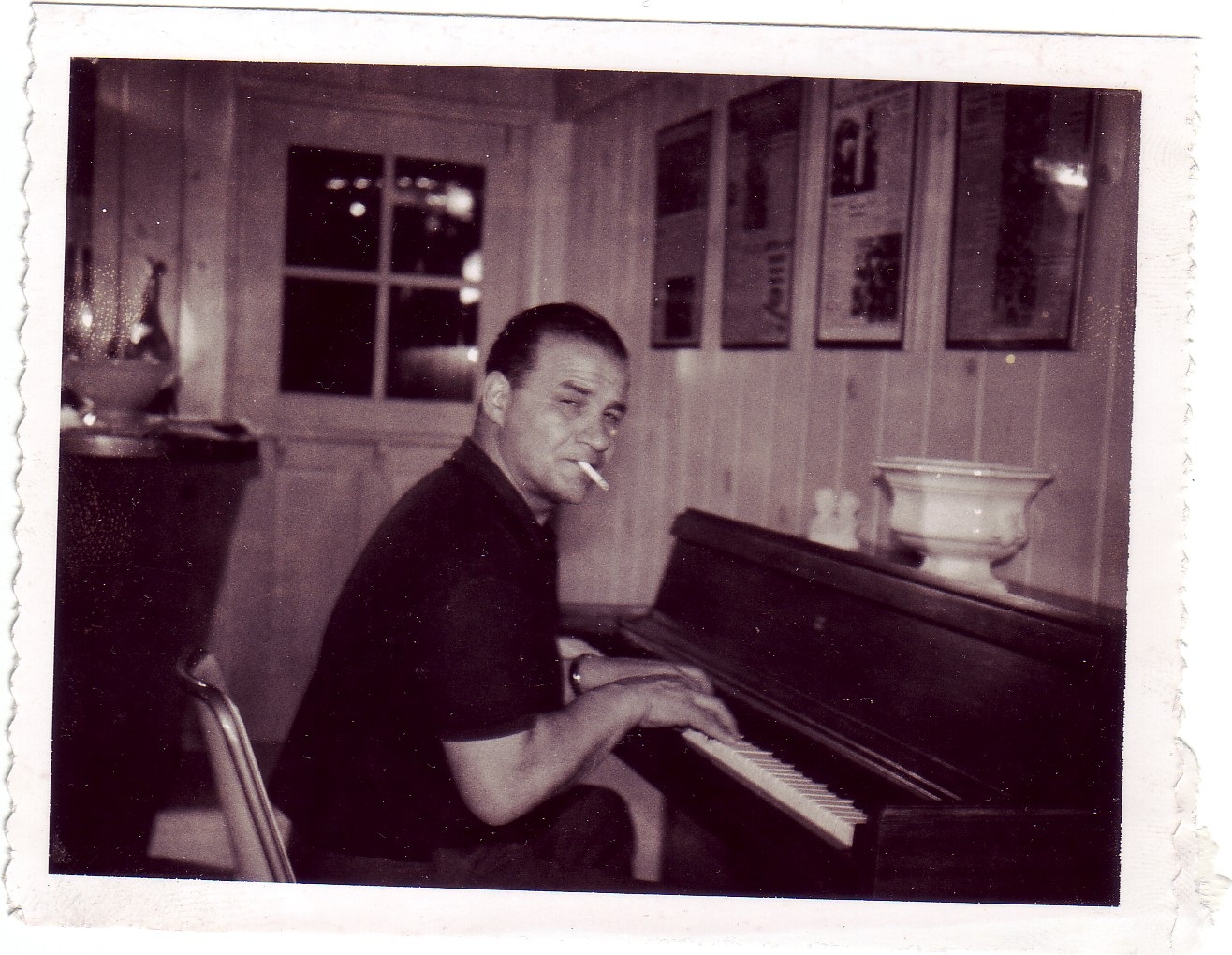
Gillman was an accomplished piano player. His mother started him on lessons when he was 7 years old and living on the north side of Minneapolis. He got good enough on that spinet to join a few bands in high school and college and keep himself well-styled.

“When I was in high school,” Gillman once said, “I was the best dressed man because of the extra money I made.”

Obviously, he didn’t make it a career (though he once held a summer job playing the keys at a honkeytonk during prohibition where he collected tips from a glass dish that sat on top of his piano). But it was an important facet of his life for quite a while. In fact, the first time he ever encountered his future wife, Esther, was when he was sitting behind a baby grand, providing the background music of a Sweet 16 party many decades ago.

I write about his piano-playing in the book, even if it became just a passing fancy once he grew to be a big-time football coach. But one of the concessions I had to make for the final draft of the book was to exclude Gillman’s love of jazz. It was intriguing and compelling – at the very least, it helped round out his character – but quite honestly, I couldn’t figure out where to place it in the book. Never could find a home for his obsession with jazz. Or, as one feature writer from the late 1960s penned, “To Sid, jazz is the elixir, the cure-all, the youth machine, even in defeat a precious ennobling balm to the spirit.”

Gillman loved jazz so much that one writer who penned an article entitled “The Old Man is the Hippest“ couldn’t stop himself from gushing about Gillman’s top-notch 33 rpm vinyl collection – which featured mostly jazz artists like McCoy Tyner, Nina Simone, Cannonball Adderley, Dave Brubeck and Fatha Hines (with the exception of Simone, who died four months after Gillman in 2003, I know nothing about any of these musicians, though Brubeck is still apparently alive and well at 92 years old).

As for rock music, here’s what Gillman had to say in 1968: “No musicianship. The big trouble is that most rock n roll musicians are terrible. On the other hand, some of the Beatles songs are great, very pretty and they sound fine when good musicians play them*, like a Buddy Rich or Wes Montgomery or Quincy Jones. Rock n roll is still young, still groping and maybe something good will come out of it. But as yet they don’t have much of a game plan.** It just isn’t very interesting.”

*Is Gillman saying here that the Beatles weren’t good musicians? That’s kind of what it sounds like. But hey, at least none of them played the clarinet, am I right? (Don’t worry, you’ll get there in a minute.)

**Even when discussing one of the other loves of his life, Gillman just couldn’t stay away from the football analogies.***

***To further illustrate that point, here’s what Gillman once said about his idol in high school, a near-blind pianist named Art Tatum: “Tatum was the greatest of them all. He commanded that keyboard like a quarterback calling a perfect game. When Tatum improvised, he was Unitas, Starr, Van Brocklin rolled into one.”

In one of those feature stories from 1968, Gillman was asked to name his all-time all-star jazz team. Though I couldn’t figure out a way to shoehorn the results into the book, I present it to you here. Because it was a passion of Gillman’s, and because … why the hell not?

  • Piano: Oscar Peterson (“But I want some backup pianists in there – Ahmad Jamal, Bill Evans, Denny Zeitlin, Bobby Timmons, Red Garland and Billy Taylor.”)
  • Guitar: Wes Montgomery
  • Saxophone: Cannonball Adderley, Bud Shank, Paul Desmond, Gerry Mulligan on baritone
  • Clarinet: None (“That’s a lost instrument. You just don’t hear much good clarinet anymore.”)
  • Trombone: J.J. Johnson, Kai Winding, the whole Stan Kenton trombone section
  • Bass: Ray Brown (“Who else?”)
  • Trumpet: Dizzy Gillespie, plus Miles Davis, Nat Adderley, Clark Terry and Bobby Bryant
  • Drums: Buddy Rich
  • Vibraphone: Terry Gibbs
  • Singer: Ella Fitzgerald, Sarah Vaughan, Billy Eckstine, Buddy Greco
  • Co-coaches: Quincy Jones for composing and Shorty Rogers for arranging
  • Team captain: Dizzy Gillespie
  • Consultant: Duke Ellington
  • As Gillman said at the end of that recitation: “There’s my team. Have tux, will travel.”

    In reality, the all-time all-star jazz team is a detail that’s probably only worth the 1,200 words I just dropped on it here (and it’s probably not even worth that). Which is why you won’t find it in the book. But that’s OK. This particular detail didn’t deserve to make the book. My only regret with the exclusion, though, is this: I just wish I could have figured out a way to write about Gillman’s disappointment with that era’s music – with the birth of rock n roll and the death of the clarinet.

    Please help my friend

    I posted this earlier today on my Twitter account, but if you’d like to donate $10 (or more) to my friend, Amy Swann, I’ll enter you in a drawing to win a free autographed copy of Sid Gillman: Father of the Passing Game. And if that’s not enough, I’ll throw in a hug from me (level of strength and duration to be determined) or, if you’re not down with that, a hearty handshake and a grateful pat on the back.

    From my fingers to your ears:

    Here’s Amy’s website. Please help if you can.

    Writing a biography on a lost soul

    Sid Gillman, in so many of the interviews I’ve read of him, wasn’t especially forthcoming. Well, that might not necessarily be true. When the interviewer wasn’t asking questions about Sid specifically – if the queries tilted toward his team or about football or about the famous coaches he knew and supported – he was fine. I don’t think he loved dealing with reporters* and I think he especially didn’t love talking about himself.

    I mean, good lord, look at some of the answers Sid gave to Todd Tobias in this interview a couple years before Sid died. Could he have said anything less when asked about himself?

    *There is a great story in my book about Sid swearing off reading the newspapers after getting into a spat with the media during his first season with the Los Angeles Rams in 1955. The legendary L.A. sports columnist Mel Durslag told me that Sid swore off reading the papers forever. Durslag asked Sid what he would do during breakfast instead of reading the local rags. “I’m going to eat my eggs and look out the goddamn window,” Sid smartly replied.

    Still, I really could have used Sid – who died in 2003 – during the time I wrote his biography.

    Especially when I had to write about how he grew up in Minneapolis. Or what he thought about leaving an African American player behind when Miami (Ohio) was invited to play in the 1947 Sun Bowl and the Sun Bowl officials forbid black players from competing. Or about his offensive philosophies or about if he knew forcing his 1963 Chargers team to take steroids could have long-term consequences on those individuals’ lives?

    Would he have answered my controversial questions? Probably not. Or he would have tap-danced around him. Or he would have gotten pissed at me and eaten his eggs while ignoring me and looking out the goddamn window. Still, like I wrote in the intro of my book — due out Aug. 29 Sept. 11 (apparently) — it’s tougher to write the story of a man when you can’t shake his hand and talk to him face to face.

    I had long and multiple interviews with each of his four kids, and all of them were great. All were forthcoming about their father, the good and the bad. Yet they couldn’t tell me stories about Sid growing up and they couldn’t get inside Sid’s head during the most meaningful moments of his life.

    But Sid’s not here, and so we must find a way to move past it.

    I just finished reading Richard Ben Cramer’s fantastic biography on Joe DiMaggio, and though the Yankee Clipper was alive when Cramer was researching and writing the book, DiMaggio refused to speak to him. But at least Cramer could observe some of DiMaggio’s actions (and there is a great scene at the beginning of the book with Cramer watching DiMaggio during his last appearance at Yankee Stadium). Me? I didn’t know anything about Gillman until five years after he died. Except for old film, there wasn’t much of anything for me to observe.

    So, how do you write a biography about a dead person? I didn’t know. Naturally, I googled it.**

    **To be clear, I used google for this exercise only. I did not use it to figure out how to write a biography of Sid Gillman. I do wonder, though, if this knowledge would have made the book better if I had actually thought to do this before I started.

    According to this site, writing on somebody who’s dead is easier because “Information about them can be easier to obtain, and they can’t complain when you mention their underwear, etc.” Yes, information about Sid’s personal life was MUCH easier to obtain from the newspapers that didn’t write about it. I mean, thank the lord I couldn’t ask Sid directly about that kind of stuff. Really dodged a bullet there. And the chances of me writing about anybody’s underwear – whether Sid was alive or dead – were pretty slim (though I do have a rather-innocent story in the book about Gillman buying a kimono for his wife that he thought made her look like a geisha girl).

    Let’s try eHow. “Follow a chronological order of the person’s life if possible. Include any noteworthy accomplishments, events, tragedies, successes, and more. If the person is still living, end with un (sic) uplifting conclusion about their path for the future. If they are dead, then conclude with one of their great accomplishments.” Well, crap. I concluded my book in a cemetery. That’s no good.

    All right, for the real analysis, I turned to New York Times’ best-selling author Jeff Pearlman, who released a fantastic book on Walter Payton last year called, “Sweetness.” Payton, who died in 1999, obviously wasn’t around to help Pearlman (or hinder him, I suppose), and since this was Pearlman’s first book on somebody who’s dead (previous bios include Roger Clemens and Barry Bonds), I asked about his approach to the Payton tome.

    “I guess, Josh, it’s not all that different from the Bonds and Clemens bios I wrote,” Pearlman wrote in an e-mail. “Neither man spoke with me, so – in a way – with Sweetness it felt normal. That said, the thing that I found interesting is how, for lack of a better word, haunted I felt. I would take these long runs at night and feel Payton next to me, running along and talking up his life. That sounds pretty insane – and it’s not like I actually believed he was there. But I just couldn’t shake that idea; that he was somehow reading over my shoulder.

    “Truth be told, it might be easier when someone isn’t around. A. He isn’t there to be annoyed at you; B. (Most important) he can’t tell people not to talk to you; C. People probably feel more at ease talking, knowing Walter wouldn’t get mad at them.

    “All that said, I wish he were alive …”

    I felt the same way about Sid. And I can understand where Pearlman was coming from when talking about going for runs with Payton in spirit. When I traveled to Los Angeles to interview two of Sid’s children in March 2011, I visited the graves of Sid and his wife, Esther. I told them both that I would do my best to present a fair assessment of his life and his life’s work. I would try my hardest to make sure people know who Sid Gillman was, what he did and what he meant to the game.

    But other than that, Sid never visited me during the writing of the book (UPDATE 1:00 a.m. CT: Swear to god, I was just adding the above photo of Sid, and I heard a single piano note go off in my house. Everybody else is asleep in their beds. I do not own a piano or a cat that would crawl across one. Freakin’ creepy, man). I never felt Sid reading over my shoulder. I never felt his presence. I don’t know, maybe I should have gone for more long runs late at night.

    The question of how to write a biography on someone who’s gone never really was answered, and therefore, I have little insight to give. I just wrote it. Which, I suppose, is the only way to go at it. You research, you interview, you dig, you double-check, you triple-check, and you start tapping.

    Anyway, I just hope I present a work that’s fair. I hope I did him right. I hope, like Pearlman said over and over again with his Payton book, that I gave the definitive story. And I hope somehow and in some way, Sid knows about it and would feel the same way.

    The twins are destined to crush us

    Every day, my twins, Stella and Noah, make more and more conversation. Noah will say something like, “I’m sitting on the potty backwards,” and even though he’s not actually doing anything on said potty, Julie and I will look at each other in amazement. How did he learn how to say that? We, of course, don’t have the answer. We have no idea.

    Or Stella will pull out the most heart-warming version of “thank you” on record, and we wonder, is there anything in this world that’s possibly cuter than those two words emanating from the mouth of our adorable toddler.

    Stella has been smiling more lately, and during music class a few days ago, she started rocking out with sticks and a drum. Noah can almost have a near-conversation, and when I come in the room and he says, “Oh, hi, Dada,” it’s all I can do not to burst (with laughter, with pride, with everything).

    This morning, when I was changing Stella’s diaper, she stuck her hand inside the decorative blanket on the wall and asked, “Where did my hand go?” After I expressed my puzzlement at this perplexing query, she yanked it out and said, “There it is.” Earlier, Noah dropped something out of his crib, and he said, “Oh no, it fell.”

    Yesterday, Stella asked Julie out of nowhere, “What’s the matter?” Before that, when I asked Noah if he wanted some pancakes, he said, “Um ……… yes,” like he was deep in thought and really contemplating the matter.

    It’s all cute. It’s all wonderful.

    It’s also a little heart-crushing. Because my kids are growing up. People say all the time, “Oh, they grow up so fast.” I haven’t felt that yet. It feels like Stella and Noah have been here for almost 2 1/2 years exactly. It’s been a life-changing, fantastic 2 1/2 years. It’s also been a long 2 1/2 years.

    But I have made an effort to live in the moment as much as I can. That’s why I go in for second good-nights (and second kisses) most every evening. Yes, I let the kids watch a little too much Sesame Street probably (is five hours a day REALLY too much, though?), but I also feel very present in their lives, moving with them in real time. When the kids start going to school, maybe I’ll feel different. Maybe I’ll feel their youth slipping away too quickly.

    But that’s the thing: they’re growing up. Maybe that should thrill me to no end, but it doesn’t. It makes me (a little bit) sad. I remember when the twins began rolling over and, then, began readying themselves to crawl. During that time span, I almost dreaded the moment they’d begin to crawl forward (or, in Stella’s case, backward). It was just another step in their lives, a step closer out the door, leaving behind old mom and dad to relive the memories of their children’s youth.

    I imagine that it’s a normal feeling for a parent to experience, but it also feels a little selfish. I wasn’t rooting against my kids, but I wasn’t completely sad when they failed at their task.

    And now, they talk. And tomorrow, they’ll talk some more and learn new words. And the next day, they’ll amaze us once again. At some point, Noah will catch a baseball and Stella won’t need my help getting into a swing. Until, one day, they’ll be just little kids having a conversation with us as they get set to graduate high school and get their first job and high-tail it out of here for the rest of their lives.

    Julie and I are so proud of all the kids’ accomplishments. Noah has been rocking the hell out of some rather difficult puzzles, and Stella is doing forward rolls. They are such lovely toddlers with sweet personalities and staggering intelligence. I just wish time would slow down a little. Not because it’s going too fast. It’s just so that I can savor every accomplishment just a little more. So Julie and I can laugh just a little longer when Stella hands Noah a toy and he says matter-of-factly, “Thank you, Stella,” like he’s been saying it for years.

    So we can hold them closer to our hearts before, through no fault of their own and as is to be expected, they eventually break them.

    Those who have it harder than me (triplets)

    Whenever a friend or an acquaintance or, quite honestly, a stranger learns that my wife and I have twins, one of the first responses is usually something along the lines of, “Oh my gosh, I don’t know how you do it.” My answer usually is, “Well, I don’t have much choice in the matter,” or “Well, since these are my two first kids, this is completely normal to me.” These aren’t conversations that occur every so often. They’re weekly discussions, seems like.

    Stella and Noah have been really good babies and toddlers, and much of the time, they make our lives relatively simple and pain-free. At this point, I can’t imagine not having twins. And I can think of other parents who have it much harder than us. These are the people who deserve the sympathetic remarks. These are the people who deserve medals. That’s why I started this occasional series – originally for manofthehouse.com – called “Those who have it harder than me.”

    Today, we talk to Damon Hack, who covers golf for Sports Illustrated (you can find him on Twitter here). I’d met Damon a few times covering various sporting events, but I’d heard recently that his wife had given birth to triplets. When I ran into him at Super Bowl Media Day in Indianapolis in February, I talked with him for a few minutes so he could describe to me just what it’s like to raise three babies at the same time. At the end of our talk, I thought to myself, “I don’t know how he does it …”

    Previous editions of Those Who Have it Harder than Me:

    My baby has colic

    After a stillborn birth

    Josh Katzowitz: For us, having twins probably isn’t twice the work. It’s probably more like 1 ½ times the work. It’s not too bad. But my and wife I have talked about it: what about triplets? We’re like, ‘How do those parents possibly do it?’ because we know how hard raising two at the same time can be. Tell me about your life with triplets.

    Damon Hack:
    My wife’s pregnancy was really good. She went 34 weeks, which was amazing with triplets. The last week, she had bed-rest because she had mild preeclampsia, which is when the blood pressure kind of goes up and own. She gave birth on June 9, 2011, and she had a quick drop in blood pressure right after the deliveries, so they had to give her a couple IVs. I’m sitting there in the room with her, and I’m watching her numbers drop. I’m freaking out, and she’s half-asleep.

    When I think about the changes to our lives, I think of the whole thing. I think of the pregnancy, giving her chocolate Ensure, the things I used to give my grandmother for bone density. It’s really important for the dad and husband to be involved. I wanted to be involved, and you want to go through the pregnancy with them. I just wanted to be a part of the process and be a real good support system for her.

    Katzowitz:
    For twins, when they wake up in the morning, you can literally grab them at the same time and walk downstairs with them together in both of your arms. Logistically, how do you do that with three babies?

    Hack:
    We’re lucky, because we have help. As you know, I’m a sports writer and I’m on the road a lot, and my wife has her own business. We actually have had baby nurse help since they were born. It’s been the only way we can function. We’ve had times where it’s just me and my wife, and you get through it. But one baby has to stay down. When we don’t have anybody helping us, you do it in order. You feed one baby, you feed the second baby, you feed the third. But you alternate it. You don’t have the same baby not eat first every night.

    Katzowitz:
    You make it fair.

    Hack: Yes. And what we’re discovering now, is that you want to spend time with each child individually. My wife will take one child on a baby date. She’ll take James one day, Rhys one day and Miles one day. I’ll do the same thing. We have two dogs, so our house is a complete circus. When I walk the dogs, I’ll put on the Baby Bjorn and take one of my boys with me. It’s great bonding time and a chance for the boys to see what’s going on outside.

    Katzowitz
    : That is great. That individual time is something we strive to do, but it’s tough. You really have to work to make that happen, because it is important to get that one on one.

    Hack: Absolutely. They’re going to be together a lot. They’re in the same room. Meal time is the same for them when we have our full complement of help. But we bathe them one at a time. We try to get them in a routine. That’s the thing. Everybody talks about it. You go to sleep at the same time. Bath time is at the same time. Nap time.

    Katzowitz:
    We were lucky because our kids are easy going, but one of the things we did early on was with sleep. It was one down, both down.

    Hack: Exactly, you have to do it.

    Katzowitz: You have to have a break at some point.

    Hack:
    It’s just for your sanity’s sake. You know, once a week, my wife and I go out on a date night. We have babysitting help, and you don’t want to completely lose yourself. Sometimes, you can’t help but lose yourself to the kids, and it’s important to do so. But sometimes you want to be an individual too and be romantic with your spouse and remind yourself how you got into this trouble in the first place.

    But I’ve been tired for eight months. I’ve carried this fatigue with me for eight months. It’s hard to catch up and get back on top with your sleep. When I’m on the road – this week in the Super Bowl – I’ll get more sleep then I ever do.

    Katzowitz:
    When did you guys find out, and what was your reaction? It took me a long time to wrap my head around the idea of twins.

    Hack: We first thought we were having twins. We had one of our ultrasounds, and they saw two. We went back two weeks later, and they saw the third one. I couldn’t believe it. I was in shock. In some ways, I’m still in shock when I walk in the room and see three babies in there. We wanted to have a baby for so long, and it really is a blessing. But it’s a shock also. Most people have one baby, so that’s what you’re used to seeing. But now you see commercials for twins and triplets.

    But once you’re there, it’s special. We’re “the triplet family” in our neighborhood. My wife’s family is in Queens, we live in the city, and we’ve had aunts come over. It’s a special, special designation to be a parent of multiples. It’s really awesome.

    Katzowitz: I’m not trying to pry, but we get a lot of the, ‘Oh, do twins run in your family?’ question. Which is code for, ‘Oh, did you have reproductive help?”

    Hack: I get that a lot.

    Katzowitz: How do you handle that?

    Hack: I’m honest. Maybe it’s because I’m being a journalist, but because we wanted kids for so long, we had to get help. For whatever reason, medically we couldn’t get pregnant, so we had to do in vitro fertilization. And it worked.

    Katzowitz: It worked very well, apparently.

    Hack: It worked too well, some would say. No, it worked perfectly well, as far as we’re concerned. But people do pry, because it’s a curiosity. Do triplets run in your family? I’ve gotten that question a hundred times.

    Katzowitz: Do you feel like it’s code?

    Hack: Yeah, I’ve had some people straight-up ask me if we’ve used in vitro.

    Katzowitz: Oh, yeah. People have asked me that. To me, it’s rude.

    Hack: It’s noisy and it can be rude. People don’t know what we’ve gone through. There are ups and downs. We didn’t get through on the first in vitro fertilization.

    Katzowitz:
    Oh my god, that’s a lot of money.

    Hack: It’s a lot of money and stress. But thankfully, all’s well that ends well. I don’t mind telling people, because of those who are struggling and can afford it, at least it’s an option. I share it, because of how happy we are with the end result.

    The newspaper guy who adapted to the present

    I didn’t know Craig Stanke well. I met him face to face in June 2011 when we had a CBSSports.com NFL get-together in Fort Lauderdale. The first night all of us (the writers, the bloggers and the editors) were in town, we ate dinner at a relatively expensive steakhouse, and afterward, Craig expressed disappointment, because – even though we had ordered plenty of alcohol, appetizers, steaks, seafood and dessert – the bill was too cheap for his CBS expense account.

    We should have ordered an extra side of shrimp or the creamed spinach a la carte or that fourth Maker’s and ginger. We were supposed to make it hurt, and we had failed.

    I remember thinking to myself as he laughed at our weak attempt to blow a small hole in the monetary budget, “This guy … well, this guy is a newspaper guy.”

    The truth is, Stanke, who died in his sleep Monday night at the age of 56, seemed to love newspapers but he also seemed to have lost his lust for them. Like I said, I didn’t know him all that well,* but he was a guy who worked at south Florida newspapers before turning to the internet in 1997, where he eventually became the deputy managing editor at CBSSports.com. Basically, he was the guy who ran the day-to-day operations of the outfit. You had a story to pitch? You went to Stanke. You had a problem? You went to Stanke.

    *To read an excellent column by one of his best friends, the L.A. Times’ T.J. Simers, click here, and this one from CBSSports.com’s Scott Miller is a standout as well.

    Craig and I were Facebook friends – it was through social media, really, that I got a sense of his wit and his love affair with running – and as his discontent with the South Florida Sun Sentinel grew, it seemed that his status updates regarding his hometown paper turned desperate. Eventually, he cancelled his subscription, and although the decision, I suppose, was inevitable, he seemed saddened by it. He was a newspaper guy living through the demise of his hometown rag. He had a great job in journalism’s present and was preparing hard for the future, but he also seemed disappointed that the newspaper era in which he had toiled for two decades was on the road to irrelevance.

    Especially since he had made such an impact in newsprint. Not just in the south, mind you, but in the north and the west. From his LinkedIn page, this is was his career.

    His last job was at CBSSports.com, but suffice to say, he was a newspaper guy through and through.

    Which is the attitude he took when he interacted with his writers.

    I always got a kick out of his e-mails on style. You know, the kind of email where he’d chide remind us that Stanley Cup Final had no “S” at the end of Final or that NBA Finals did or informing us of the latest AP style changes or that it was coach Mike Shanahan and not head coach Mike Shanahan. He’d usually sign off with something like, “There shouldn’t be any questions, but if there are, ask.” I always laughed at that, probably because it reminded me of something my mentor, Conrad Fink, would have said. Like, “You should know better, but if I have to save your ass again, I guess that I will.”

    He also helped get me into Super Bowl XLV. Originally, only two of the three Eye on Football bloggers were supposed to have seats in the auxiliary press box. I lost the lottery, meaning I would write from Dallas all Super Bowl week but I wouldn’t be in attendance at Cowboys Stadium. Until Stanke stepped in at the last minute and finagled for me a pass to the media workroom next to the field. I had to watch the game on TV, but I still was a part of the live coverage team (and truthfully, I sneaked into a sweet pregame party on field level that my brethren in the press box didn’t know about. I toasted my freshly-cut prime rib to Stanke that night). Anyway, when he called to tell me the good news, I asked him where the media center was, and he said in kind of an exasperated way, “I don’t know, Josh. But I got you into the stadium.” Indeed he did, and I appreciated it. I guess I never really told him that.

    About a year ago, I wrote a piece for the website in which an NFL quarterback from the 1970s let loose a, “F— Drew Brees” comment. I wrote it – led with that quote, actually – and the day it appeared, the former QB called me. He was pissed, and he let me know about it. After spending 30 minutes on the phone with the QB, I dialed Stanke to give him the heads up that I had been called. Even though I was bugging him at home, Stanke took 10 minutes to let me know that everything was cool and that he stood with me behind that story and the way it had been presented.

    I figured that story and that quote would blow over in a few days, and it did. And even though I wasn’t upset that the QB was upset at me, it was nice to hear Stanke’s voice of reassurance.

    For a newspaper guy, he took to online journalism quite well. He landed a high-level job at one of the most prestigious national sites around, and he did something inventive with Twitter, where he used his account to tweet out the daily CBSSports.com story budget. His nearly 1,300 followers got details every day about who was writing what and when it would be online. The point, I think, was so that the viewer could sit in virtually on the budget meetings, so that readers could go behind the scenes for a brief moment. This wasn’t the thought process of most newspaper guys, but like a buddy of mine said, Stanke was the kind of editor who could bridge the gap between the dead tree days and what it means to be an online journalist today.

    Stanke’s twitter account was great, and that’s the kind of stuff that makes the internet great (I mean, Twitter and the Internet. Wrong style. Sorry, Stanke). Craig understood that.

    The last 24 hours have been a time of sadness, and though I didn’t know him well, reading his Facebook page and his Twitter mentions shows that his impact on journalism and on the world in general was something to behold. I was excited to see him next week at this year’s NFL summit for us at CBSSports.com. I was ready to help make that dinner bill extravagantly expensive. Now, we’ll have to do it to honor for Stanke – the runner, the online adapter, the editor, the man who was loved by many and respected by even more.

    Here’s hoping the Sun Sentinel runs a big obituary on Stanke in the newspaper on Tuesday, a 20-inch black and white eulogy with maybe a mug shot of Craig’s grinning face. One last toast to the man who left newspapers behind. I imagine he would have enjoyed that.

    My first conversation with my son

    May 16, 2012 (4:24 p.m.): Stella and Noah just woke up from their naps, and as I was changing Noah’s diaper, I noticed a wound on his left elbow. It looked red and angry, and obviously, it was fresh. I had worked today, so I wasn’t around for most of the morning.

    It was certainly something new.

    “What’s that on your elbow?” I asked.
    “I hurt it,” he said.
    “Does it hurt?”
    “Yes,” he said with a definitive nod.
    “What happened?”
    “I fall off.”
    “You fell off what?”
    No answer.
    “You fell off what?”
    “I fall off.”
    Silence.
    Then, Noah: “Outside.”
    “You were outside?”
    “Take-a shoes off.”
    “You were outside and you took your shoes off and you fell?”
    “Yes, I fall off.”
    “You fell off what?”
    “Picture!” he squealed as he noticed me slipping my iPhone out of my pocket in attempt to record our chat.

    And that was the conversation Noah and I just had. It was exhilarating, if not altogether enlightening. But the fact it was somewhat informative is, I don’t know, incredible. The fact he can string together six words in a sentence is, like I imagine it is for any first-time parent, a stunning marvel. The fact Stella is not far behind fills us with pride. The fact we can have some semblance of a conversation for the first time is a marvel.

    We try not to be overly-complimentary with the kids as they develop with rapid speed in their day to day lives. We don’t praise the heavens every time they accomplish a new task or simply repeat the same ones they’ve done before. But man, sometimes it’s hard.

    Sometimes, the words, “Great job,” escapes before you can bottle them behind your lips. I didn’t let Noah know I was blown away by our conversation, but I was.

    I never did find out what he fell off (though we later surmised he probably tumbled to the concrete when he was playing in the backyard), and I guess I never will. I’m just stunned he gave me even the faintest idea of what happened.

    Sid Gillman, Gregg Williams and bounties

    With so much talk in past few weeks about former Saints defensive coordinator Gregg Williams and his vile pregame speech before last year’s 49ers game, former NFL player and current player-agent Ralph Cindrich penned an interesting tweet.

    Cindrich played as a linebacker in the NFL for four seasons in the 1970s with the Patriots, Oilers and the Broncos, and during his tenure, he was coached by at least two legends (Sid Gillman and Bum Phillips).

    Basically, Cindrich asked himself this question: if his own coaches had the opportunity, would they have overseen (and/or encouraged) a bounty program – the kind of program that led to a one-year suspension for New Orleans coach Sean Payton and an indefinite suspension for Williams? Here was his conclusion.

    Regarding Gillman, I agree. One theme of my upcoming book (COMING OUT THIS SUMMER!) is that while Gillman wanted to do the right thing much, if not most, of the time, winning ultimately triumphed everything. There were instances in his career when Gillman, intentionally or not, did wrong by his players in order to win. Some decisions, I believe, he regretted. Others, he probably didn’t. If Gillman felt he could have gained an advantage by offering a bounty, I would guess that he wouldn’t hesitate to do so.

    I asked Cindrich, after his initial tweet, if he was saying that Gillman HAD taken part in bounties or that he WOULD have participated, and Cindrich responded this way:

    I also agree with this take.

    It’s unfortunate that Gillman is no longer around to ask about this issue (christ, how many times did I say that while writing my book?). And if he had been asked, I imagine he would have denied it whether he had or hadn’t or whether he believed he would or wouldn’t.

    But I’m also guessing many of his former players, and not just Cindrich, would wholeheartedly agree with the assertion that Gillman would have made the same decision as Payton. Hell, I found articles from the mid-1970s where Oilers players complained that he was putting them at extreme and unneccessary risk during practice.

    I don’t quite understand that mindset – screw everything else; win at all costs – but it’s also why Gillman is such a fascinating figure to write about. Gillman, with all his greatness, still had plenty of warts. Just like Payton and Williams; just like many of the most successful pro coaches in history. Luckily for Gillman (and perhaps unluckily for me), nobody taped his pregame speeches and then slathered them on the Internet for all to see and for all to judge.

    Do not – I repeat – do not …

    … break your penis. This should be obvious, but sometimes, it’s nice to have a helpful reminder. And if you do happen to break your penis, please don’t show it to me in a public restroom. Unless, of course, I ask first.

    Farewell Peyton Manning

    With the news that the Colts most likely will release quarterback Peyton Manning, an Indianapolis era is over. Manning was the one who led the moribund franchise into a perennial Super Bowl contender. He’s the one that led the Colts to the world title. He’s the one who helped convince the NFL to place Super Bowl XLVI in Lucas Oil Stadium. Hell, Manning is one of the main reasons Lucas Oil Stadium was erected in the first place.

    So, it’ll be a sad day when the Colts say goodbye to one of the top players in NFL history.

    And it’s a sad day for the reporters who covered him, as Indianapolis Star columnist Bob Kravitz put it on Twitter. “It was a joy and a privilege to watch and cover Peyton Manning. Always a class act, went out of his way to accommodate us. … One example: After nite games, PM would talk to us right away, usually in full pads, knowing we were on deadline and in a rush. Appreciated.”

    I know what Kravitz means, because it was Manning 14 years ago who saved me from what could have been one of the most embarrassing moments of my young career.

    Read the rest of my CBSSports.com column here.